
Accent Variety in TTS: Global Voice Options Guide | Cliptics
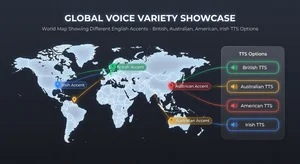
When our company launched internationally, we made a critical mistake with our voice-over content. We used a single American English TTS voice for every market. US, UK, Australia, India, South Africa. The script was identical, just the American accent reading to everyone.
The feedback from UK customers was swift and pointed: "Why does this sound like an American selling to me?" Australian users felt the same. Indian customers mentioned the voice felt disconnected from local context. We'd assumed English is English. We were wrong.
Accents carry cultural identity, regional authenticity, and subconscious trust signals. When you hear your own accent, content feels made for you. When you hear a foreign accent, it signals outsider perspective. sometimes fine, often problematic depending on context.
After that expensive lesson, we rebuilt our audio strategy around accent diversity. British English for UK markets. Australian English for Australia. Indian English for India. The content remained identical, but the voices changed. Engagement increased 28% in non-US English markets. Customer feedback shifted from "why does this sound American" to "this feels like it's made for us."
That experience taught me that accent isn't just pronunciation variation. it's cultural communication. For global brands, content creators, and anyone reaching international audiences, understanding and using accent variety in TTS is essential. Here's what actually works.
Why Accent Matters More Than Language
Most people understand the importance of translating content into different languages. Speak Spanish to Spanish speakers, French to French speakers. That's obvious. What's less obvious but equally important: speak English with appropriate accents to different English-speaking populations.
English is a genuinely global language, but it's not monolithic. British English differs from American English in vocabulary, grammar, and pronunciation. Australian, Indian, South African, Irish, and dozens of other English varieties have their own characteristics. These aren't inferior or incorrect. they're legitimate regional variations.
When brands ignore accent diversity, they communicate unconscious centrism. Using only American English suggests "American is default, everyone else is variation." Using British English for all English content makes the same mistake from a different center. The message, intentional or not, is exclusionary.
Respecting accent diversity signals inclusion, cultural awareness, and that you see specific audiences rather than homogenizing everyone into a default category. That matters for brand perception and effectiveness.
For creators and brands operating internationally, accent-appropriate TTS isn't about political correctness. it's about communication effectiveness and showing audiences you've actually considered their specific context.
Understanding Major English Accent Categories
English accent diversity is vast, but certain major categories matter most for TTS selection:
American English: Itself diverse (Southern, New York, Midwestern), but "General American" or "broadcast American" is the standard for U.S.-targeted content. Americans generally expect this accent for commercial and informational content.
British English: Similarly diverse internally (Cockney, Scottish, Welsh, Northern, RP), but "Received Pronunciation" or modern BBC English serves as standard British English for professional content targeting UK audiences.
Australian English: Distinct from both American and British, with characteristic vowel sounds and intonation patterns. Australian audiences strongly prefer Australian accents for local content.
Canadian English: Sits between American and British, with regional variations. Often uses slightly different vocabulary than American English despite sounding similar.
Irish English: Both Republic of Ireland and Northern Ireland variations exist, distinct from British English despite geographic proximity.
Indian English: Extremely important given India's population. Indian English has become its own standard variety, not "British English with Indian accent" but a legitimate regional standard.
South African English: Distinct characteristics influenced by Afrikaans and indigenous languages. Growing importance as South African digital market expands.

New Zealand English: Similar to Australian but distinct enough that New Zealanders notice and prefer their own accent representation.
Caribbean English: Multiple varieties across Caribbean nations, each with unique characteristics blending British colonial influence with local linguistic patterns.
For TTS selection, understanding these categories helps you match voices to target audiences appropriately.
Selecting Accent-Appropriate TTS Voices
How do you actually choose which accents to use for different contexts? Here's my decision framework:
Primary audience geography: Where are you reaching people? Use the accent standard for that region. Content for UK audiences should use British English. Content for Australian audiences should use Australian English. This seems obvious but gets overlooked constantly.
Brand positioning: If your brand has strong geographic identity, maintaining that accent might be strategic. A quintessentially British brand might use British accents globally as part of brand identity. But recognize this creates trade-offs in local authenticity.
Content context: Educational content, news, and information often benefit from "neutral" prestigious accents (General American, RP British). Marketing content benefits more from local accent matching to target audiences.
Audience diversity: If reaching truly global audiences simultaneously (international conferences, global platforms), you might need multiple accent versions or choose an accent with broadest comprehension. General American often fills this role due to media exposure, though British English works similarly.
Budget and practicality: Creating multiple accent versions costs more than single versions. Prioritize accent diversity for highest-value markets or audiences. You might create British, American, and Australian versions but use one of those for smaller markets like New Zealand or Ireland.
Platform capabilities: Does your TTS platform offer the accents you need? Not all platforms have comprehensive accent libraries. British English TTS, Australian English TTS, and Spanish TTS availability varies by platform.
Testing with native speakers: Before committing to accent choices, test with actual native speakers from target regions. Can they identify obvious non-native elements? Does the accent sound natural or artificial to them?
The goal isn't achieving perfect native accent (humans rarely manage that across regions). The goal is close enough that audiences don't find the accent distracting or feel like outsiders to the content.
Technical Accent Quality Evaluation
Not all TTS "British English" or "Australian English" options are equal. Evaluating accent quality prevents costly mistakes:
Authentic phonetics: Do vowel sounds, consonants, and intonation patterns match the target accent accurately? Poor TTS sometimes creates caricatures. exaggerated features that native speakers find jarring.
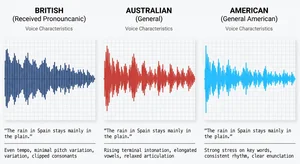
Natural prosody: Does the rhythm and melody of speech match how native speakers actually talk? Prosody varies significantly between accents. American English is relatively flat intonation. British English has more pitch variation. Getting prosody wrong makes accents sound artificial.
Vocabulary and phrasing: Some TTS platforms adjust vocabulary to match accents (British "lift" vs. American "elevator"). This attention to detail increases authenticity significantly.
Consistency: Does the accent maintain consistency throughout longer content? Some TTS systems slip between accent features inconsistently, which sounds unprofessional.
Regional specificity: Does the platform offer generic "British English" or specific varieties (Scottish, Welsh, Northern)? For most commercial uses, standard British English works, but specific regional targeting might need more granular options.
Gender and age variety: Are accent options available across different genders and age ranges? You might need British English voices that sound young, middle-aged, and older for different content types.
Listen to extended samples before committing. Brief demos often hide quality issues that emerge in longer content. Test full paragraph reading, not just isolated sentences.
Multilingual Content Strategy
Beyond English accent variety, truly global content often requires multiple languages with appropriate native accents:
Prioritize by market size: Create localized versions for largest markets first. Spanish, Mandarin Chinese, Hindi, Arabic, Portuguese, French, German, Japanese represent massive user bases.
Consider regional language variations: Spanish varies significantly between Spain and Latin America. Portuguese differs between Brazil and Portugal. Arabic has multiple regional variations. Choose varieties matching your target audiences within language groups.
Native speaker quality control: Always have native speakers review translations and voice selection. TTS quality varies dramatically across languages. What sounds natural in English might sound robotic in other languages on the same platform.
Cultural adaptation, not just translation: Effective localization adapts content culturally, not just linguistically. Humor, references, examples might need changing for different audiences. TTS accent is one piece of broader cultural adaptation.
Technical considerations: Some languages have specific TTS challenges. Tonal languages (Mandarin, Vietnamese) require especially good prosody. Languages with complex phonetics (Polish, Arabic) need high-quality models. Research platform capabilities per language before committing.
Maintenance across versions: Creating multiple language/accent versions means maintaining multiple versions as content updates. Build workflows that keep all versions synchronized without excessive manual overhead.
Tools offering broad language and accent support include text-to-speech services with international libraries and multilingual TTS platforms supporting diverse global audiences.
Accent in Brand Voice and Identity
How does accent fit into broader brand voice strategy?
Consistent but context-appropriate: Your brand voice should remain consistent (tone, personality, values) while accent adapts to audience context. The "what you say" stays consistent; the "how it sounds" adapts.
Geographic brand identity: Brands with strong geographic identity (Texas-based, British luxury, Australian casual) might intentionally maintain origin-accent across markets as brand authenticity marker. This works when geographic origin is part of brand value proposition.
Neutral versus local: For global tech platforms or services without strong geographic identity, localized accents usually work better. Users want the platform to feel adapted to them, not imposed from elsewhere.
Customer service considerations: Support and service interactions especially benefit from accent matching. Customers with problems want to feel understood. Accent similarity creates subconscious rapport that helps service interactions.
Marketing versus instruction: Marketing content might benefit more from native accent authenticity. Instructional content might work with "neutral" prestige accents that transcend regions. Consider content purpose when making accent decisions.
Evolution and flexibility: Your accent strategy might evolve as you grow. Starting in one market with one accent, then expanding to accent diversity as you reach new markets, is normal. Build flexibility into systems rather than committing to single-accent approaches.
Common Accent-Related Mistakes
Through consulting with global brands, I've identified recurring accent-related errors:
Assuming English is English: The biggest mistake. Treating all English speakers as interchangeable ignores meaningful regional identity and preference. Always segment English-speaking audiences by region.
Accent caricature: Using exaggerated stereotypical accents (think Lucky Charms leprechaun for Irish) offends rather than connects. Aim for authentic standard regional accents, not entertainment caricatures.
Mismatched content and accent: Using American accent for content about British culture or British accent for American-focused content creates jarring disconnects. Match accent to content context, not just audience location.
Inconsistent accent mixing: Switching accents within content without clear purpose confuses audiences. If multiple characters in dialogue have different accents, that's natural. But randomly varying the narrator accent is disorienting.
Neglecting accent testing: Assuming your American ear correctly evaluates British accent quality, or vice versa, leads to poor choices. Always test accents with native speakers from target regions.
Over-localizing too quickly: Creating 15 accent variations for modest audiences in each region wastes resources. Prioritize major markets first, expand accent diversity as audience and revenue justify the investment.
Measuring Accent Impact
How do you know if accent strategy is working? Several metrics help:
Engagement by region: Compare engagement metrics (completion rates, time spent, interaction) across regions with local accents versus generic accents. Properly localized content typically shows 15-30% engagement lifts.
Customer satisfaction feedback: In customer service contexts, satisfaction scores often improve with accent-matched interactions. Survey customers about whether voice experiences feel locally relevant.
A/B testing: Run controlled tests showing some users localized accents and others generic accents. Measure completion, conversion, satisfaction differences. This provides hard data on accent impact.
Localization ROI: Calculate cost of creating multiple accent versions versus revenue or engagement gains from better localization. This justifies accent investment to stakeholders who question the expense.
Qualitative feedback: Monitor comments, reviews, and feedback mentioning voice or accent. "Finally sounds like it's made for us" versus "why does this sound American/British" provides direct insight.
Market-specific performance: Track whether markets with localized accents perform better on key metrics (acquisition, retention, conversion) than markets using generic accents. This demonstrates business impact.
Setup Workflow
Practically adding accent diversity requires systematic approach:
Audit current accent usage: What accents do you currently use? Where are they deployed? Which audiences encounter which accents? Understanding current state clarifies what needs changing.
Map audiences to accents: Document which audiences you serve and which accents would appropriately serve each. This becomes your accent strategy roadmap.
Evaluate platform capabilities: Does your current TTS platform support needed accents? If not, evaluate alternatives or plan platform migration to access necessary accent diversity.
Prioritize setup: Which accent additions deliver most value? Usually major English-speaking markets (US, UK, Australia) get priority, followed by largest non-English markets.
Create production workflows: How will you efficiently generate, organize, and deploy multiple accent versions? Build systems that make ongoing accent diversity manageable, not burdensome.
Quality assurance process: How will you verify accent quality and appropriateness before deployment? Build native speaker review into production workflow.
Monitoring and optimization: Track performance by accent version. Continuously improve based on data and feedback. Accent strategy should evolve based on real-world results.
The Global Communication Imperative
As businesses and creators reach increasingly global audiences, accent awareness becomes non-negotiable. The internet erased geographic boundaries for content distribution. But it didn't erase cultural and linguistic identity.
Global audiences want content that respects their specific context. including accent. Brands succeeding internationally recognize accent as important as translation. It's localization at the level of sound itself.
This doesn't mean every piece of content needs 20 accent variations. It means thoughtfully considering which audiences matter most and what accent appropriately serves each. It means building systems supporting accent diversity as natural part of content production. It means testing and iterating based on actual audience response.
The technology exists. TTS platforms offer accent diversity. The question is whether creators and brands will use these capabilities thoughtfully or default to easiest single-accent approaches that serve some audiences while alienating others.
For anyone serious about global reach, accent variety isn't optional extra. it's fundamental to communication effectiveness and respect for diverse audiences. The organizations getting this right build deeper connections, stronger engagement, and more loyal global audiences.
That's worth the extra effort of accent diversity, one carefully chosen voice at a time.