The 2026 Complete Guide to Agentic AI Content Systems for | Cliptics

The term "agentic AI" is getting used to describe everything from a chatbot with memory to a fully autonomous multi-agent system that manages an entire business function. For solo creators, the practical question isn't the terminology. It's whether AI can run enough of the marketing funnel that the creative human at the center can focus on what actually requires their specific expertise.
The honest answer in 2026: yes, more of it than most solo creators realize, and no, not all of it yet. Understanding which parts can be genuinely automated versus which parts still need human judgment is the strategic literacy that separates creators who are working efficiently from those who are perpetually behind.
What "Agentic" Actually Means for a Solo Creator
Agentic AI refers to systems that take sequences of actions toward a goal, making decisions along the way rather than executing a single task and stopping. Traditional AI tools respond to a single prompt and return a single output. Agentic systems can chain tasks, observe outcomes, and adapt their approach.
For a solo creator, the practical implication is the difference between "generate me a caption for this post" and a system that monitors your posting schedule, drafts captions for your upcoming content, generates hashtag sets, schedules posts, monitors engagement on published content, and flags what performed well as signal for future content creation.
That second system sounds aspirational. Versions of it are operational in 2026 using a combination of AI content tools, automation platforms (Zapier, Make, n8n), and the suite of AI tools available from platforms like Cliptics.
The Four Layers of the Content Funnel That Can Be Automated
Before designing an automated system, you need a clear view of which funnel layers are automatable and which require human input.
Layer 1 - Content ideation: Highly automatable. AI can analyze your existing best-performing content, monitor trends in your niche, and generate content ideas at scale. The human role here is selection and perspective-adding, not generation.
Layer 2 - Content creation: Partially automatable. First drafts, structural outlines, social media adaptations of long-form content, and format conversions (written to audio, written to video script) are automatable. The original insight, the specific voice, and the quality judgment still require the human creator.
Layer 3 - Distribution: Highly automatable. Scheduling, cross-platform posting, hashtag application, format adaptation for different platforms, and basic community management responses are fully automatable with current tools.
Layer 4 - Analytics and optimization: Partially automatable. Data collection and basic pattern identification are automatable. Strategic interpretation of what the patterns mean and how to respond requires human judgment.
Building the Ideation Layer
The ideation layer starts with the tools that generate and organize content ideas based on inputs you define.
AI content idea generators (including tools on Cliptics) take niche, audience type, and content goals as inputs and return a range of angles, formats, and topic combinations. The key to making this layer work as a system rather than a one-time tool use is creating a structured ideation cadence.
Run a weekly ideation session: 20 minutes, every Monday. Use the AI to generate 30-40 ideas based on your niche and any specific timely angles (seasonal content, trending topics, product launches). Select 8-10 for your content calendar. The AI generates the raw material; your selection creates the editorial voice.
Store approved ideas in a structured backlog (Notion or Airtable work well). The backlog should always have at least 4-6 weeks of approved ideas. When your backlog gets low, run another ideation session.
Building the Creation Layer
The creation layer is where human contribution is highest and automation is most selective.
For long-form written content (newsletters, blog posts, LinkedIn articles), the practical system is AI-assisted drafting: the human creates the outline and key points, the AI generates a first draft structured around those points, and the human revises and adds their specific perspective and examples.
For social content adapted from long-form: automate the adaptation. A 1,200-word blog post can be adapted into 5-7 social captions, a short-form video script, and a thread format by an AI that understands your voice and the platform requirements. This is the content multiplication layer that scales your output without multiplying your creation effort.
For audio content: AI text-to-speech converts written content into audio without recording time. This creates a podcast-adjacent asset from every substantial written piece without additional production work.
The Distribution Automation Stack
Distribution is where automation earns its keep most clearly, because it's the most mechanical part of the funnel and the most time-consuming if done manually.
The distribution automation stack for a solo creator typically involves:
- A scheduling tool (Buffer, Hootsuite, Later) that handles multi-platform publishing from a single queue
- An automation platform (Zapier or Make) that connects your content production tools to your scheduling tools
- Platform-specific optimization (hashtag sets, caption length, image format variations) that can be templated and applied automatically
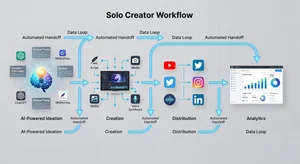
The trigger-action model: when you finalize a piece of content (mark it as ready in Notion, for example), an automation can detect this, generate platform-specific adaptations, schedule them across your active platforms, and notify you of the schedule. Your manual step is the trigger; everything after it is automated.
Closing the Loop: Analytics Automation
The analytics layer completes the automated feedback cycle that makes the system genuinely agentic rather than just automated.
Connect your platform analytics to a centralized dashboard (many solo creators use Notion or a Google Sheet fed by Zapier automations that pull platform metrics). Define your signal metrics clearly: what are the indicators that a piece of content succeeded by your specific definition?
Weekly, the system surfaces which content performed above your baseline threshold. This becomes input for your Monday ideation session: generate more content in the directions that worked. The AI ideation layer can incorporate these performance signals directly if you structure your ideation prompts to include top-performing topic categories.
This creates a closed loop: ideation informed by performance data, creation informed by validated ideas, distribution automated based on creation output, analytics fed back into ideation.
What Remains Irreducibly Human
The system handles volume and consistency. The human handles voice, judgment, and relationships.
Your specific point of view on your niche is not automatable. Your responses to audience comments that build actual relationships are not automatable at the quality level that matters. Your ability to recognize when a trend is worth ignoring versus worth addressing is not automatable.
The creators who use agentic content systems most effectively aren't trying to remove themselves from the funnel. They're trying to remove themselves from the mechanical, repetitive, and time-consuming parts of the funnel so they can be present for the parts that genuinely require them.
That's the design principle: automate everything you'd happily pay someone to do that doesn't require your specific knowledge. Keep everything that only you can do with the quality that makes your work worth following.
Getting Started Without Overwhelm
The system I've described sounds complex when presented all at once. The practical path is building one layer at a time.
Week 1: Set up ideation automation. Run weekly ideation sessions with AI and build your 6-week idea backlog.
Month 1: Add distribution automation. Connect your existing content to a scheduling tool and build your platform templates.
Month 2: Add the content multiplication layer. Build your process for adapting long-form content to social formats with AI assistance.
Month 3: Add analytics feedback loops. Build your dashboard and define your signal metrics.
Each layer delivers value independently. The full system emerges from building them in sequence, each one making the next more valuable. Solo creators who build this incrementally end up with a genuinely agentic content operation rather than a collection of unconnected AI tools.


The goal isn't to be a creator who uses AI. It's to be a creator whose system runs on AI so the creator part, the actual creative work, gets your full attention.