AI Art vs Human Art: The Creative Debate That's Tearing | Cliptics
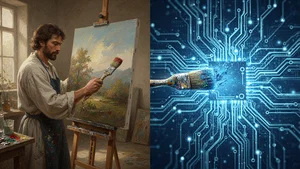
I watched two friends almost stop speaking to each other last week. Over art.
One is a digital painter who has spent fifteen years building a career on DeviantArt and ArtStation. The other is a designer who uses AI generation tools daily for client work. They got into it at dinner about whether AI art is "real art," and the conversation went sideways fast.
The painter said AI tools are strip-mining human creativity. The designer said gatekeeping creativity is elitist. Neither was entirely wrong. Neither was entirely right.
That exchange stuck with me because it captures something bigger happening across the entire creative world right now. This isn't a casual disagreement. It's a fundamental clash about what art is, who gets to make it, and what happens to the people who have dedicated their lives to mastering a craft.
I've been sitting with this for a while, talking to artists on both sides, reading everything I can find. Here's what I've come to understand about this debate, and why both sides have more in common than they think.
The Case for Human Art
Let's start with the human side, because I think it often gets flattened into nostalgia by tech enthusiasts, and that's not fair.
When a painter spends six hours mixing a particular shade of blue because it captures how the sky looked on the morning their father died, that blue means something. It carries lived experience. Emotional weight. Intention that cannot be replicated by a prompt.
Human art is messy. It's inefficient. It takes years to develop skill, and the process of developing that skill changes the artist. The struggle is the point. Every failed sketch, every canvas thrown away, every moment of frustration feeds into the next piece. The work carries all of that invisible history.
Traditional artists also point to something critics call "the hand." That subtle imperfection, the slight wobble in a brushstroke, the particular way someone cross-hatches that becomes as recognizable as a fingerprint. These aren't flaws. They're signatures. They're proof that a specific human being stood in front of a canvas and made a thousand tiny decisions, each one reflecting who they are.
And there's the economic reality. Illustrators, concept artists, and freelance creatives have watched their livelihoods compress in real time. Commission rates have dropped. Clients who used to hire illustrators now generate images themselves. Art directors at studios increasingly use AI for initial concepts, reducing the number of human artists needed in the pipeline. This isn't hypothetical harm. It's happening right now, and pretending otherwise is dishonest.
The Case for AI Art
Now the other side, which also gets unfairly caricatured as lazy people who can't draw wanting to skip the hard work.
AI art tools have done something genuinely unprecedented. They've given creative expression to people who never had access to it. A teenager in a rural town who can't afford art school or supplies can now visualize the stories in their head. A small business owner who needs a logo doesn't have to choose between a thousand dollar designer and clip art. A person with a physical disability that makes traditional art difficult can now create visual works.
That democratization is real, and dismissing it as laziness misses the point entirely.
There's also a philosophical argument worth taking seriously. Every artistic tool in history was controversial when it first appeared. Photography was going to kill painting. It didn't. Digital art was going to kill traditional art. It didn't. Photoshop was going to make skill irrelevant. It didn't, but it did change what "skill" meant in certain contexts.
AI image generation is the latest in that lineage. It's a tool. A remarkably powerful one, but still a tool.
And prompting, whatever people say about it, is not nothing. Getting a genuinely compelling image from an AI generator requires understanding composition, color theory, mood, style references, and visual language. The skill ceiling for AI art is higher than people assume. Spending time with tools like Cliptics' AI image generator or Midjourney quickly reveals that the gap between a lazy prompt and a thoughtful one is enormous. The tool amplifies intention. It doesn't replace it.
Where the Debate Gets Honest
The real tension isn't about whether AI images look good. They do. That's settled. The tension is about three deeper questions.
First, consent. Most AI image models were trained on billions of images scraped from the internet without the explicit permission of the artists who created them. This is a legitimate grievance. Artists whose distinctive styles can now be replicated on demand never agreed to that. The "fair use" legal arguments are still working their way through courts, but the ethical question stands independent of the legal one. Taking someone's life's work to train a model that competes with them feels wrong to a lot of people, regardless of what the law eventually decides.
Second, attribution. When an AI generates an image "in the style of" a specific artist, who deserves credit? The person who wrote the prompt? The thousands of artists whose work trained the model? The engineers who built it? There's no clean answer, and the lack of one creates real friction.
Third, meaning. This is the most philosophical question, and maybe the most important. Does art require intention to be art? If a human curates, prompts, selects, and refines an AI-generated image with deep intentionality, is the result less meaningful than a painting made by hand? What about AI-assisted art where a human does most of the work but uses AI for specific elements?
These questions don't have easy answers. Anyone who tells you they do is selling something.
What Both Sides Get Wrong
The human art side sometimes falls into a kind of purity argument that doesn't hold up under scrutiny. The idea that "real" art must involve physical skill excludes entire categories of accepted art. Conceptual art. Found art. Collage. Photography, when it first emerged. Readymades. Marcel Duchamp submitted a urinal to an art exhibition in 1917 and it's now one of the most influential art pieces of the twentieth century. Art has never been exclusively about technical skill.
The AI art side sometimes dismisses the very real economic harm to working artists with a hand wave about progress. "Buggy whip makers lost their jobs too" is easy to say when it's not your career being disrupted. The displacement of creative professionals deserves better than a shrug and a reference to historical inevitability.
Both sides also tend to talk past each other because they're arguing about different things. Human art advocates are often talking about cultural value and artistic meaning. AI art advocates are often talking about access and capability. These aren't contradictory positions. They're addressing different dimensions of the same issue.
Where I Think This Actually Lands
After months of thinking about this, here's where I've settled. For now.
AI art and human art are going to coexist. Not because that's the ideal outcome, but because that's already reality. The question isn't whether AI art tools will exist. They exist. The question is what norms, ethics, and structures we build around them.
I think we need better consent mechanisms for training data. Artists should have meaningful opt-out options, and ideally opt-in. Some newer models are moving in this direction, and that matters.
I think AI-generated work should be labeled as such. Not as a scarlet letter, but as basic transparency. Audiences deserve to know what they're looking at. That's not anti-AI. That's pro-honesty.
I think human-made art will become more valuable, not less. When AI can generate a million images in a day, the thing that becomes scarce and therefore precious is the human touch. The hand. The story behind the work. The years of practice embedded in every line. Paradoxically, AI might make human art more appreciated, not less.
And I think the artists who thrive will be the ones who find their own relationship with these tools, whether that means using them, rejecting them, or combining human and AI approaches in ways we haven't imagined yet.
The Part Nobody Talks About
There's a quiet truth underneath all the arguments. Both traditional artists and AI art enthusiasts care about the same thing: making something that moves people.
The painter who mixes that particular blue cares about evoking emotion. The designer who crafts a careful prompt cares about creating something that resonates. They're both trying to say something. To show something. To make someone feel something they didn't feel before.
That shared impulse, the drive to create, is what makes this debate so heated. Neither side is arguing from cynicism. They're both arguing from love. Love of art. Love of creation. Love of the feeling you get when you make something that didn't exist before.
Maybe the debate isn't really about AI vs human at all. Maybe it's about figuring out, together, what creativity means in a world where the tools keep changing but the human need to express ourselves never does.
I don't know where this lands in five years. Nobody does. But I know that the conversation matters, and that listening to both sides with genuine openness is the only way forward that doesn't leave something valuable behind.