AI Drug Discovery: How AI Is Designing Medicines From Scratch | Cliptics
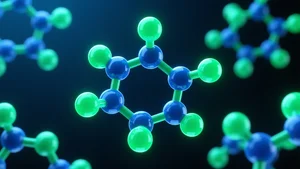
Something happened in pharmaceutical research over the past two years that most people completely missed. While everyone was busy debating AI chatbots and image generators, a quieter revolution was unfolding in labs across the world. AI started designing medicines from scratch. Not tweaking existing drugs. Not suggesting modifications. Actually inventing entirely new molecular structures that never existed before.
And here is the part that really got me: one of those AI designed molecules is now being tested in humans. With a $2.75 billion deal backing it.
The Old Way Was Painfully Slow
To understand why this matters, you need to know how drug discovery traditionally works. A pharmaceutical company identifies a disease target, usually a protein that is misbehaving in the body. Then they screen millions of chemical compounds, hoping one sticks to that protein in just the right way. Most do not. The ones that do often fail in animal testing. The rare survivors then face years of clinical trials. The whole process takes 10 to 15 years and costs roughly $2.6 billion per approved drug.
That is not a typo. Billions of dollars and over a decade of work. For a single medicine. And the failure rate sits around 90%.
So when researchers at Insilico Medicine used generative AI to go from identifying a target to entering Phase II clinical trials in under 30 months, the pharmaceutical industry paid attention. Their drug, ISM001-055, targets idiopathic pulmonary fibrosis, a devastating lung disease with limited treatment options. The AI did not just find the target. It designed the molecule too. From nothing.
How AI Actually Designs a Drug
The process is fascinating and honestly a bit mind bending. Instead of screening existing compound libraries, generative AI models learn the underlying patterns of molecular chemistry. They understand which atomic arrangements tend to bind to specific proteins, which structures are likely to be toxic, and which shapes can survive the harsh journey through the human body.
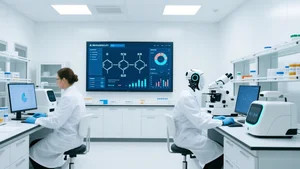
Think of it like this. A traditional drug hunter walks into a library of millions of books, hoping one contains the answer. An AI drug designer writes a new book specifically tailored to the question.
DeepMind's AlphaFold changed the game by predicting protein structures with remarkable accuracy. AlphaFold 3 went further, modeling how proteins interact with potential drug molecules, DNA, and other biological components. That structural understanding became the foundation for everything that followed. Researchers at MIT took this further with a model called BoltzGen, released in late 2025, which generates novel protein binders ready to enter the drug discovery pipeline. They also received a grant from ARPA-H to use generative AI to design 15 new antibiotics from scratch.
Meanwhile, a collaboration between MIT and Recursion Pharmaceuticals produced Boltz-2, a model that predicts not only protein structure but also how well a potential drug will bind to its target. That binding prediction is crucial. A molecule might look perfect on paper but fail to actually grab onto the protein it is supposed to affect.
The Numbers Tell the Real Story
Insilico Medicine's Phase IIa results for ISM001-055 showed something remarkable. Patients receiving 60 mg of the drug saw their lung capacity improve by 98.4 mL. The placebo group declined by 62.3 mL. That is a meaningful difference for a disease that progressively steals your ability to breathe.
Eli Lilly clearly agreed. In March 2026, they signed a deal worth up to $2.75 billion with Insilico, paying $115 million upfront. That is not speculative investment. That is one of the world's largest pharmaceutical companies betting serious money on AI designed drugs.
Recursion Pharmaceuticals has five clinical programs advancing and 15 discovery programs, backed by partnerships with Sanofi, Roche, Bayer, and Merck that have generated over $500 million. Their supercomputer BioHive-2 ranked 35th on the global TOP500 list, delivering 2 exaflops of AI performance through 504 NVIDIA H100 GPUs. They are processing biological data at a scale that would have been unimaginable five years ago.
Across the industry, 173 AI discovered drug programs are now in clinical trials. That number alone signals a fundamental shift.
What Could Go Wrong
I want to be honest about the risks here, because the hype around AI in pharma is real and it sometimes outpaces reality.
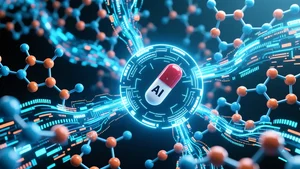
Not a single AI designed drug has received full regulatory approval yet. Phase II success does not guarantee Phase III success. Many drugs that look promising in smaller trials fail in larger ones. The biology of human disease is staggeringly complex, and AI models, no matter how sophisticated, are still working with incomplete information.
AlphaFold, for all its brilliance, struggles with highly flexible proteins and dynamic conformational changes. These are exactly the kinds of movements that matter when a drug binds to its target. Newer models like Genesis Molecular AI's Pearl claim better accuracy for certain drug relevant predictions, but the field is still young.
There is also the question of what AI optimizes for. An AI might design a molecule that binds perfectly to a target but causes unexpected side effects in humans. Biology has a way of surprising us.
Why 2026 Is the Year That Matters
Multiple AI designed drugs are entering Phase III trials this year. These are the large scale studies that determine whether a drug actually works well enough to be approved. The results will either validate a decade of investment or force the industry to recalibrate its expectations.
But even in a scenario where some of these drugs fail, the underlying technology is not going away. AI has already proven it can compress timelines dramatically. It can explore chemical spaces that no human team could cover. It can identify targets and design molecules in months instead of years.
The question is no longer whether AI belongs in drug discovery. It is already there. The real question is how quickly it moves from supporting role to lead actor. And based on what I have seen in the data, the clinical results, and the billions being invested, that transition is happening faster than most people realize.
What keeps me thinking about this late at night is not the technology itself. It is what it means for the person diagnosed with a rare disease who currently has no treatment options. If AI can cut the discovery timeline from a decade to 18 months, that is not an incremental improvement. That is the difference between hope and no hope at all.