
Virtual Hairstyle Try-On: Simulate 100+ Hairstyles Before | Cliptics
There is a specific kind of anxiety that happens in the salon chair. You have described your vision as precisely as you could. The stylist nodded. They started cutting. And halfway through you realize that the photo you showed them and the hairstyle now taking shape on your head are telling two very different stories.
Hair grows back. But at roughly half an inch per month, a mistake you discover too late can take a year to fully correct. Virtual hairstyle simulators exist to close the gap between what you imagine and what you will actually look like.
In 2026, the technology has reached a level of realism that makes virtual try-on genuinely useful as a planning tool. Here is how to use it effectively.
Why Hairstyle Simulators Are Different Now
Earlier versions of virtual hairstyle tools placed a 2D wig-like graphic over your photo. The result was unconvincing because it ignored your actual head shape, hair texture direction, and face-specific proportions.
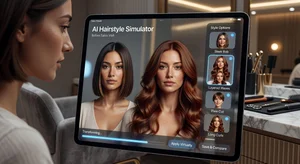
Modern AI hairstyle simulators analyze your facial structure, skin tone, and existing hair to render new styles in a way that accounts for these variables. The output looks like you with a different hairstyle, not like a filtered photo.
Cliptics AI Hairstyle Changer supports this realistic rendering approach for both women's and men's styles, including cuts, lengths, and color changes.
For men specifically: Cliptics AI Men's Hairstyle Changer For women specifically: Cliptics AI Women's Hairstyle Changer For color changes without cutting: Cliptics AI Hair Color Changer
Matching Hairstyles to Face Shape
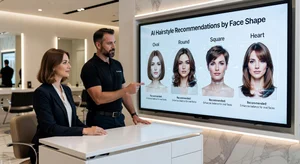
Face shape is one of the most reliable guides for hairstyle selection. Understanding your face shape before your salon visit gives you a framework for narrowing hundreds of options down to a more manageable set.
Oval face shape: The most versatile shape. Almost all hairstyle categories work well. The face is balanced with forehead and jawline roughly equal width and the face slightly longer than wide. Experiment freely.
Round face shape: Hairstyles that add height or length minimize the roundness. High-volume styles, long layers, and longer cuts generally work well. Avoid blunt bobs and chin-length cuts that emphasize width.
Square face shape: Defined jawline is the characteristic feature. Soft layers, waves, and styles with side parts soften the angular features. Avoid very short, blunt cuts that highlight the jaw without softening it.
Heart face shape: Wider forehead tapering to a narrower chin. Chin-length bobs, lobs (long bobs), and medium-length styles with volume at the bottom create balance. Side-swept bangs minimize forehead width.
Oblong/rectangular face shape: Longer than wide. Side parts, waves, and medium-length styles with horizontal visual weight create the appearance of proportion. Avoid very long, straight styles that add more length.
Diamond face shape: Wide at cheekbones, narrower forehead and jaw. Styles that add width at the forehead and chin (bangs, chin-length cuts) create visual balance.
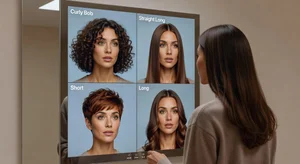
The virtual try-on tool lets you test how different styles actually look on your specific face shape, moving beyond the general guidelines to see your personal result.
The 100+ Styles Worth Exploring
Virtual try-on makes it practical to explore styles you might never have considered. Some worth experimenting with:
For shorter cuts: Pixie cuts in their many variations (disconnected pixie, textured pixie, asymmetrical pixie). Buzz cuts and their graduated variations. Undercuts with longer top sections.
For medium lengths: The classic lob (long bob) in straight, wavy, or textured versions. The French bob. The curtain bang lob. The blunt cut bob at various lengths from chin to shoulder.
For longer styles: Layers vs one-length. Beachy waves vs sleek straight. The butterfly cut. Long shag with curtain bangs.
For color changes without cutting: Balayage, highlights, lowlights, ombre. Vivid color experiments (blue, pink, copper) are particularly risky without a preview. Single-process all-over color in shades lighter or darker than your natural color.
For texture changes: Straightening naturally curly hair (virtually, before you invest in the permanent treatment). Adding waves or curls to straight hair.
Using the Simulator Effectively Before Your Salon Visit
The goal is not to arrive at the salon with a single photo and insist it be replicated exactly. The goal is to arrive with a clear sense of the direction you want.
Step 1: Take a good reference photo. Use a well-lit, straight-on photo showing your full face. Pull your hair back from your face so the simulator can work with your natural face shape. Avoid heavy filters.
Step 2: Explore broadly first. Try styles you would normally dismiss immediately. You might discover that a cut you assumed would not work for your face actually looks great on you.
Step 3: Narrow down to 3 to 5 favorites. Save screenshots of the results you like most.
Step 4: Try color changes separately. Use Cliptics AI Hair Color Changer to preview color options on your selected styles. Color changes are often more dramatic and harder to reverse than cuts.
Step 5: Bring your screenshots to the consultation. Show your stylist both what you liked and what you did not like. This gives them more information than a single "inspiration photo" from a model who looks nothing like you.
Having the Conversation with Your Stylist
Virtual try-on improves the consultation conversation but does not replace it. Your stylist has expertise in texture, maintenance requirements, and how your specific hair type will behave with different cuts.
Use your virtual try-on results as a starting point: "I tried these styles in a simulator and liked this direction. Does my hair type work well with this cut?" A good stylist will tell you if there is a reason a particular style will not translate to your specific hair.
Also ask about maintenance. The style that looks great in the simulator might require 45 minutes of daily styling to maintain. Knowing this before you commit saves significant future frustration.
Virtual hairstyle technology has reached the point where it genuinely improves decisions. The visual confidence of knowing what to expect eliminates the anxiety of the unknown. Your next salon visit can start with clarity instead of hope.
Try the styles you have always been curious about. The only risk is discovering you love something new.