AI Language Learning: Can a Chatbot Replace Your Tutor? | Cliptics
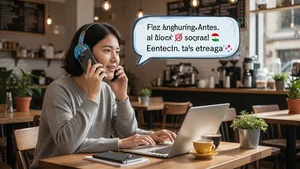
I used to dread my weekly Spanish lesson. Not because I disliked my tutor. She was lovely, patient, encouraging. But there was something about staring at a real person while butchering verb conjugations that made my brain freeze up. I would rehearse sentences in the shower, nail them perfectly, then sit down at that little screen and forget everything.
So when a friend told me she had stopped seeing her tutor entirely and was only using AI chatbots to practice Mandarin, I was genuinely curious. And a little skeptical. Could a chatbot really replace the person who had been guiding me through subjunctive mood for months?
I spent the last few weeks testing every major AI language tool I could find. What I discovered surprised me, and not entirely in the ways I expected.
The New Generation of AI Tutors
The language learning landscape in 2026 looks nothing like it did even two years ago. These are not the clunky chatbots that used to spit out robotic sentences and ignore half of what you said.
Duolingo Max now includes a Video Call feature where you can have full spoken conversations with Lily, one of their animated characters. It adapts to your proficiency level, catches your mistakes, and adjusts difficulty on the fly. The catch is the $30 per month price tag for the Max tier, which is still significantly cheaper than a human tutor but not exactly pocket change for a language app.
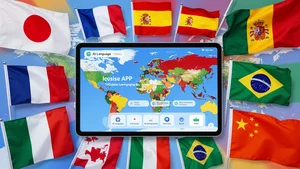
Then there is Gliglish, which has quietly built a following of over 260,000 users. It lets you practice speaking in more than 30 languages with an AI teacher that gives instant grammar feedback. You get 10 free minutes per day, which is just enough time to build a habit without spending anything.
ChatGPT's Advanced Voice Mode might be the most impressive of all. The conversations feel almost indistinguishable from talking to a real person. Zero latency. Natural interruptions. It detects pronunciation issues and gently corrects them. I tried ordering food in French through it, and the AI actually played the role of a confused Parisian waiter. That was a first.
The Numbers That Changed My Mind
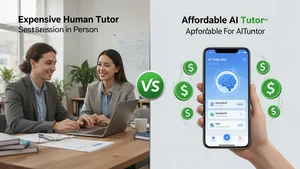
Let me be blunt about the economics. A human language tutor costs between $30 and $100 per hour, depending on the language and the tutor's experience. If you take one lesson per week, that is $120 to $400 per month. For most people, that means roughly 60 minutes of actual conversation practice each week.
An AI tutor costs between $0 and $30 per month, and you can practice for as long as you want. Thirty minutes every single day. An hour if you feel like it. At 2 AM in your pajamas if that is when motivation strikes. No scheduling, no cancellations, no awkward small talk at the start of each session.
Google Translate's live conversation feature now works across more than 70 languages and runs entirely through your headphones. You can walk up to someone speaking Tamil or Korean, and the app translates both sides of the conversation in real time, preserving tone and speaking style. It is not a tutor exactly, but it collapses the distance between "studying a language" and "actually using one" in a way nothing else has.
Babbel and Rosetta Stone have added their own AI conversation features too, though they feel more scripted. Babbel Speak guides you through scenarios with visual cues and step by step prompts. It is less freeform than ChatGPT but more structured, which some learners actually prefer.
Where AI Tutors Genuinely Fall Short
Here is where I have to be honest, because I think a lot of the hype around AI language learning glosses over real limitations.
AI cannot teach you culture. When my Spanish tutor explained why certain phrases sound rude in Mexico but perfectly fine in Spain, that came from lived experience. When she laughed at my attempt to use slang I had picked up from a TV show and told me nobody actually talks like that, that was invaluable. An AI will let you say things that are technically correct but culturally tone deaf, and it will not know the difference.
AI also struggles with accountability. My tutor noticed when I had not practiced. She could tell from my hesitation, from the way I reverted to simpler structures. She would adjust the lesson accordingly. An AI resets every session. It does not remember that you have been avoiding past tense for three weeks unless you explicitly tell it to track that.
And then there is the emotional dimension. Learning a language is vulnerable work. You sound foolish. You make embarrassing mistakes. Having a patient human who normalizes that experience, who shares their own stories of language embarrassment, who celebrates your small victories with genuine warmth... that is not something an algorithm replicates, no matter how natural its voice sounds.
The Approach That Actually Works
After all my testing, here is what I have landed on. The people making the fastest progress in 2026 are not choosing between AI and human tutors. They are using both.
The pattern looks something like this: 20 to 30 minutes of AI conversation practice every day, building volume and confidence. Then one session per week with a human tutor, focusing on the mistakes the AI did not catch, the cultural nuances, the complex grammar that needs a real explanation.
This hybrid approach costs roughly $60 to $80 per month total, and it delivers more speaking practice than either option alone. The AI handles the repetition and the low stakes practice. The human handles the depth and the correction that requires judgment.
So Can a Chatbot Replace Your Tutor?
The honest answer is: partially. For pure conversation practice, volume, and pronunciation drilling, AI has already surpassed what most human tutors can offer simply because it is always available and endlessly patient. If you have never been able to afford a tutor, AI has genuinely democratized language learning in a way that matters.
But for the deeper work of understanding how a language lives inside its culture, for the accountability that comes from a real relationship, for the kind of correction that requires human judgment and experience, a chatbot is not there yet. Maybe it will be someday. Right now, though, the best language learners I have talked to are the ones who stopped seeing it as a competition between the two.
They use the AI to show up every day. They use the human to go deep. And somewhere in that combination, they are actually learning to speak.