"Virtual Makeup Try-On: Test Before You Buy | Cliptics"
I spent $312 on makeup last month. Want to know how much of it I actually use? Maybe half. And that is being generous.
The thing is, I know better now. I have access to tools that let me see exactly how a shade will look on my face before I hand over my credit card. But old habits die hard, and every so often I fall back into the trap of buying something because it looked incredible on someone else.
That someone else has different skin, different undertones, different face shape. Of course it looks different on me. This is not rocket science. But somehow the beauty industry has convinced us to keep gambling with our money anyway.
Virtual makeup try on changes that equation completely. And in 2026, these tools have gotten genuinely good.
How Virtual Makeup Try On Actually Works Now
The technology behind virtual try on has come a long way from those clunky face filters that made everyone look like a porcelain doll. Modern AI beauty tools use real time face mapping to identify hundreds of facial landmarks. Your lip line, your brow arch, the crease of your eyelid, the contour of your cheekbones. All mapped precisely so that when you apply a virtual shade of lipstick, it follows the natural shape of your mouth.
What makes 2026 tools different from earlier versions is the rendering quality. The best platforms now account for your skin texture, undertone, and even the lighting in your room. So when you test a burgundy lip, you see how that shade interacts with your specific complexion, not some idealized version of it.
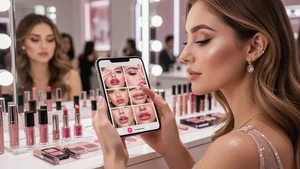
Cliptics AI Makeup Try On is one of those tools that gets this right. Upload a selfie or use your camera, and you can cycle through lipsticks, eyeshadows, blush, and full face looks in seconds. The colors render realistically, which means what you see on screen actually translates to what you will see in the mirror.
The Products Worth Testing Virtually
Here is where virtual try on saves you the most money and frustration.
Lipstick is the obvious one. A shade that looks like a soft mauve in the tube might pull completely pink on warm undertones. Or that "universally flattering" red might clash with your skin. Testing virtually eliminates the guesswork. Try twenty shades in two minutes. Save the three that actually work.
Eyeshadow palettes are even more important to preview. A $60 palette is a commitment. You want to know that those shimmery taupes will complement your eye color and that the deep plum in the corner will not make you look exhausted. Virtual try on lets you swatch each shade on your actual eyelids, blend combinations, and see the full effect before buying.
Blush and bronzer placement matters as much as color. Virtual tools now let you adjust placement and intensity, so you can figure out whether a cream blush on the apples of your cheeks gives you that fresh, dewy look or just makes you look sunburned.
Foundation matching has historically been terrible. Department store lighting is deceptive, and even shade matching machines get it wrong. AI try on tools that analyze your skin tone from a photo have gotten significantly more accurate this year.
What Changed in 2026
Three things happened this year that made virtual makeup try on genuinely useful instead of just a fun gimmick.
First, the AI models got better at handling diverse skin tones. Earlier tools were notoriously bad at rendering makeup on deeper complexions. Colors would look washed out or completely inaccurate. The latest generation of beauty AR handles the full spectrum of skin tones with much better fidelity.
Second, real time rendering got faster. Nobody wants to upload a photo and wait thirty seconds to see one lipstick shade. The tools worth using now show results instantly as you swipe through options. It feels like browsing a physical display, except you are seeing everything on your own face.
Third, product catalogs expanded dramatically. It is one thing to try on generic "red lipstick." It is another to try on the exact shade of Charlotte Tilbury Pillow Talk or MAC Ruby Woo and see how that specific formulation looks on you. Major brands like Sephora and L'Oreal have integrated virtual try on directly into their shopping experiences, but standalone tools often have broader catalogs across multiple brands.
Building a Look, Not Just Testing Shades
The real power of virtual try on is not testing individual products. It is building complete looks.
Say you are going to a wedding. You have a specific dress color, specific accessories, and a general vibe you are going for. Instead of buying products one by one and hoping they work together, you can build the entire makeup look virtually. Layer foundation, then blush, then eyeshadow, then lips. See the complete picture.
This is where standalone tools have an advantage over brand specific try on features. Sephora's tool only shows you Sephora products. A tool like Cliptics lets you experiment freely without being locked into one retailer's catalog.
You can also combine beauty tools to plan a full transformation. Curious how a new nail art design would look with your makeup look? Or wondering if colored contacts might tie the whole thing together? Testing all of these virtually before committing means no more drawer full of impulse purchases.
The Shopping Strategy That Actually Works
Here is my process now, and it has cut my wasted beauty spending by more than half.
When I spot a trend or product I like, I test it virtually first. Always. No exceptions. If it looks good in the virtual try on, I add it to a wish list. Then I wait a few days. If I still want it after the initial excitement fades, that is when I buy.
This two step filter, virtual preview plus waiting period, has been remarkably effective. The virtual preview eliminates products that simply do not work for my coloring or features. The waiting period eliminates the impulse purchases that I would have gotten bored with anyway.
For everyday looks, I have settled into a rotation of about five combinations that I know work. I tested them all virtually, bought the exact products, and now my morning routine takes ten minutes instead of the twenty I used to spend trying to make ill suited products cooperate.
Who Benefits Most From Virtual Try On
Honestly, everyone who buys makeup. But some groups benefit more than others.
If you have a skin tone that is underrepresented in store displays, virtual try on is a game changer. You see how products actually look on you, not on the model in the advertisement.
If you are someone who gets overwhelmed by choice, narrowing options virtually before walking into a store makes the experience so much less stressful.
If you are exploring a completely new style, whether that is transitioning from no makeup to a polished everyday look or experimenting with bold editorial styles, virtual try on removes the financial risk from experimentation.
And if you are simply tired of wasting money on products that end up in the back of a drawer, this technology exists specifically to solve that problem. The tools are free, the results are realistic, and the savings add up faster than you would expect.
That $312 I mentioned? Next month, I am aiming for under $100, with zero regret purchases. Virtual try on makes that actually possible.