
AI Music Generation Copyright Law: Legal Guide for Content | Cliptics
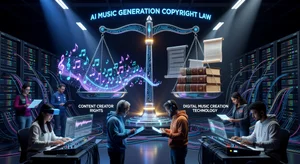
AI-generated music has created a genuine legal gray zone that is still being mapped. Content creators who use AI music in their videos, podcasts, and social media posts need to understand where the boundaries are. The rules are changing rapidly, courts are issuing significant rulings, and the platforms where you distribute content have their own policies that may differ from legal requirements.
This guide provides a practical overview of where things stand in 2026 and what it means for your content.
The Copyright Ownership Question
The foundational question in AI music copyright is: who owns music generated by an AI?
The current position of the US Copyright Office, as clarified through rulings in 2023 and 2024, is that copyright protection requires human authorship. Purely AI-generated content, created without meaningful human creative input, is not eligible for copyright protection in the United States.
This has a significant practical implication: music generated entirely by AI prompting (where a human types a description and the AI creates the music) exists in the public domain. No one owns it. Anyone can use it.
However, the situation gets more complex when human creative input is involved. If a musician uses AI tools to assist in creating music (similar to how musicians use digital audio workstations and virtual instruments), and the musician makes meaningful creative decisions about the output, copyright protection may extend to those human-creative elements.
The European Union has taken a slightly different approach. EU copyright law also requires human authorship, but the EU AI Act and related guidance suggests more flexibility for works where AI is used as a tool rather than the sole creator.
Practical Implications for Content Creators
Using publicly available AI music generators:
Services like Suno, Udio, Mubert, and similar platforms generate music from text prompts. The copyright status of the output depends on the service's terms of service and the amount of human creative direction involved.
Most of these services license the output music to users under their own terms of service. Read these carefully. Many grant commercial usage rights as part of their subscription. Some reserve the right to use your generated tracks for platform purposes. Some explicitly disclaim copyright ownership and release outputs to the public domain.
Using AI-generated music on YouTube:
YouTube's Content ID system is the most practical concern for most creators. Traditional music is registered in Content ID and automatically detected in uploaded videos. AI-generated music typically is not registered in Content ID (because no copyright owner has registered it), meaning it typically will not trigger copyright claims.
However, this is changing. Some labels have begun registering AI-generated music they claim rights to in Content ID. The platform is also developing new policies around AI-generated content generally.
Using AI-generated music on TikTok:
TikTok has its own licensed music library and commercial music library. Using music from outside these libraries in videos that are promoted commercially (boosted posts, TikTok ads) can create issues regardless of the music's AI generation status. For organic content, AI-generated music typically does not trigger claims, but TikTok is updating its policies around AI content broadly.
Using AI music commercially:
If you use AI-generated music in commercial contexts (advertisements, client work, paid content), verify the license terms of the specific tool or service you used. Most commercial AI music services offer commercial licenses for paid tiers.
The Training Data Problem
A separate legal issue affects the companies building AI music models rather than the creators using them. Several major music labels filed lawsuits in 2023 and 2024 against AI music companies, alleging that training AI models on copyrighted recordings without license violated copyright law.
As of 2026, several of these cases have proceeded through the courts, with mixed results that have significant implications for which AI music services have legal certainty about their training data and which are still in litigation.
For creators, the practical implication is that services that have settled with major labels or secured explicit licensing agreements for their training data are on more stable legal footing. Services operating without those agreements carry more uncertainty about long-term viability and potential retroactive liability.
When choosing AI music services, research their licensing status with major music rights organizations.
The Performer Rights Issue
Copyright in a song has two components in most jurisdictions: composition rights (the underlying notes and lyrics) and recording rights (the specific recorded performance). AI music generation implicates both.
An interesting case arose in the EU in 2025 around AI systems trained on specific musicians' recorded performances. The court found that AI systems trained on recordings without consent may implicate performers' rights separate from copyright, even when the resulting music is not recognizably similar to any specific recording. This is an emerging area of law with significant uncertainty.
For content creators, this primarily matters if you are working with AI music services that explicitly train on specific artists' voices or performance styles. General-purpose music generation services that create novel music without imitating specific performers are on stronger ground.
Safe Practices for Content Creators
Given the evolving legal landscape, here are the safest practices for incorporating AI music into your content:
Use services with explicit commercial licenses. Many AI music platforms provide clear commercial usage rights in their terms. Using these with an active paid subscription is the most legally secure approach.
Read the terms of service carefully. Music rights are complex enough that vague terms create risk. Look for explicit statements about: who owns the output, whether commercial use is permitted, whether the platform can use your outputs, and whether the underlying training data was licensed.
Document your AI music sources. Keep records of which service generated which tracks and when. This documentation is useful if any rights claims arise later.
Avoid services still in active litigation. AI music services with active major label lawsuits carry uncertainty about future availability and potential retroactive claims. Sticking with services that have secured label agreements reduces this risk.
Consider music licensed explicitly for content creation. Services like Epidemic Sound, Artlist, and similar platforms provide music licensed explicitly for content creators, including video, social media, and podcasting. Some of these now include AI-generated tracks alongside human-created tracks, with clear commercial licensing.
For highest-risk commercial use (paid ads, client work), get explicit advice. The legal landscape is evolving quickly enough that for significant commercial use, consulting an intellectual property attorney with AI expertise is worthwhile.
Where This Is Heading
The trajectory of AI music law is toward clearer rules. Regulatory bodies in the US, EU, and UK are all developing frameworks for AI-generated content. Several pending court cases will establish precedent that clarifies key questions.
The most likely outcome, based on current regulatory direction, is a licensing framework where AI music companies pay rights holders for training data, similar to existing mechanical licensing frameworks for human music creation. This would resolve the training data uncertainty and provide clearer rights status for the resulting music.
For content creators, the practical situation in 2026 is manageable with reasonable caution. Use licensed services, read the terms, document your sources, and stay informed as the legal landscape develops. The creative opportunity that AI music provides is real. The legal complexity is navigable.