AI Search Is Killing Website Traffic | Cliptics
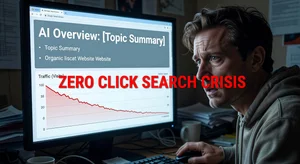
Something broke in the internet economy, and most website owners still haven't figured out what happened. Between late 2024 and now, a quiet but devastating shift rewired how people find information online. Google's AI Overviews, Perplexity, Bing Copilot, and a wave of AI-powered search engines started answering questions directly, pulling content from websites, summarizing it, and serving it to users without them ever needing to click a link.
The result is a traffic collapse that is hitting publishers, bloggers, small businesses, and SEO professionals harder than any algorithm update in Google's history. If your livelihood depends on organic search traffic, this is the single most important thing you need to understand right now.
The Numbers Tell a Brutal Story
The data is no longer debatable. Studies from Semrush and Ahrefs throughout 2025 confirmed what many webmasters already felt: informational queries saw click-through rates drop by 30 to 60 percent once AI Overviews appeared in search results. By early 2026, the decline has accelerated.
Rand Fishkin's SparkToro research pegged Google's zero-click search rate at over 65 percent in late 2025. That means nearly two-thirds of all Google searches end without the user visiting any website at all. For queries where AI Overviews are triggered, that number climbs past 80 percent.
Independent publishers report organic traffic declines of 40 to 70 percent compared to two years ago. Recipe sites, how-to blogs, health information portals, product review sites, and educational content creators have been hit the hardest. These are the exact types of content that AI can easily summarize and present directly in search results.
The pattern is consistent across industries. A travel blog that once pulled 500,000 monthly visits from Google might now see 150,000. A tech tutorial site that built its business on ranking for "how to" queries has watched its traffic fall off a cliff. The visitors aren't going elsewhere. They're simply getting their answers without clicking.
Why This Is Different From Every Previous SEO Shift
Website owners have survived Google algorithm updates before. Panda, Penguin, Helpful Content Update. Each one reshuffled the rankings, creating winners and losers. But the fundamental model stayed the same: Google sent traffic to websites, and websites competed for that traffic.
AI search breaks that model entirely. The problem isn't that your site dropped in rankings. The problem is that rankings themselves matter less when users get answers without scrolling past the AI-generated summary at the top of the page.
This is a structural change, not a cyclical one. Google isn't going to roll back AI Overviews because they reduce the need for blue links. The AI summary format is what users increasingly prefer. Google's own internal data reportedly shows higher user satisfaction scores when AI Overviews are present. From Google's perspective, giving users faster answers is a product improvement, even if it devastates the websites that supply the underlying information.
Perplexity and similar AI search engines take this even further. They don't even pretend to be a gateway to the open web. They synthesize content from multiple sources into a single coherent answer. Citation links exist, but click-through rates on those citations are a fraction of what traditional search results produce.
The Content Paradox Nobody Wants to Discuss
Here's the part that should make every content creator uncomfortable: AI search engines need your content to function. They train on it, scrape it, and summarize it to generate their answers. But they return almost nothing in exchange.
You create a detailed 3,000-word guide about home electrical wiring safety. Google's AI Overview condenses your expertise into a four-paragraph summary displayed directly in search results. The user gets their answer. You get nothing. No visit, no ad impression, no email signup, no potential customer.
This creates a perverse incentive structure. The better your content is at answering questions comprehensively, the more effectively AI can extract value from it, and the less reason users have to visit your actual site. Being the best resource on a topic now works against you in terms of traffic generation.
Some publishers have started blocking AI crawlers. The New York Times, Reddit, and several major publishers have updated their robots.txt files or negotiated licensing deals. But for small and mid-size publishers, blocking AI crawlers is a losing proposition. You risk being excluded from AI-generated results entirely while your competitors who allow crawling get cited instead.
What Is Actually Working in 2026
Surviving this shift requires abandoning the old playbook. Here is what's producing results for the publishers and businesses that are adapting.
Build direct audience relationships. Email lists, push notifications, Discord communities, and membership programs give you a traffic channel that no algorithm change can take away. Every visitor who comes to your site should encounter multiple low-friction opportunities to join your owned audience. The sites thriving right now are the ones that spent the last few years building subscriber bases instead of relying entirely on Google.
Create content that AI cannot easily summarize. Original research, proprietary data, interactive tools, video walkthroughs, case studies with real numbers, and first-person experience pieces are significantly harder for AI to compress into a quick answer. A blog post listing "10 tips for better sleep" is dead. A post documenting your personal six-month sleep optimization experiment with wearable data, photos, and specific product comparisons still pulls traffic because users want the full context.
Optimize for AI citation rather than traditional ranking. This is the new SEO. Structure your content so that AI systems are likely to cite you as a source. Clear, authoritative, fact-dense paragraphs that directly answer specific questions get cited more frequently. Include original statistics, named sources, and unique data points that AI systems identify as citable material. Getting a Perplexity citation with a 3 percent click-through rate is better than getting no visibility at all.
Shift monetization away from pure traffic dependence. Ad revenue models that rely on pageviews are in structural decline. Affiliate revenue is holding up better because purchase-intent queries still generate clicks. People want to compare products on actual websites before buying. Digital products, courses, consulting services, SaaS tools, and community memberships convert at rates that can sustain a business even with dramatically reduced traffic volumes.
Double down on branded search. Nobody asks AI "what does Brand X think about this topic." They go to your site directly. Building brand recognition through social media, podcasts, YouTube, and partnerships means users search for you by name, bypassing AI summaries entirely. Branded search traffic has held steady or grown for publishers who invested in name recognition.
Target queries where AI Overviews don't appear. Not every search triggers an AI summary. Commercial queries, comparison queries, local searches, and highly subjective topics still drive traditional clicks. Use Semrush or Ahrefs to identify keywords in your niche where AI Overviews are absent and concentrate your content efforts there.
The Uncomfortable Long-Term Picture
The honest assessment is that the open web as a traffic space is contracting and will continue to contract. AI search is not a temporary disruption. It is a permanent restructuring of how information flows online.
Some categories of websites will effectively cease to exist as viable businesses within the next two to three years. Thin content aggregators, basic how-to sites, and any publisher whose primary value proposition is "we organized publicly available information in a readable format" are facing extinction.
What survives is content that provides something AI cannot replicate: genuine expertise, original reporting, unique data, community interaction, and real human perspective. The bar for what constitutes valuable content has been raised dramatically, and it's not coming back down.
The website owners who acknowledge this reality and restructure their businesses around it will find opportunities in the wreckage. Those waiting for traffic to bounce back are waiting for something that is not coming.
What You Should Do This Week
Stop looking at your traffic dashboards and hoping for recovery. Instead, audit your content to identify what AI can easily replace and what it cannot. Start building or expanding your email list today, not next quarter. Evaluate your revenue model and begin diversifying away from pure ad dependence. Research which of your target keywords still produce clicks versus which have been absorbed by AI Overviews.
The crisis is real, it is accelerating, and the window to adapt is narrowing. The website owners who act now will be the ones still standing when the dust settles.