AI Synthetic Data Generation 75% of Businesses Use It | Cliptics
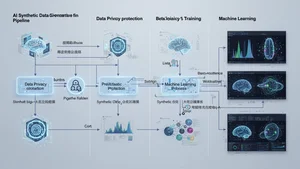
Seventy-five percent of businesses now use synthetic data for AI training, testing, or analytics. What started as a privacy workaround has become standard practice for accelerating AI development. The quality reached the point where synthetic data often performs better than real data for many applications.
I've worked with a dozen companies implementing synthetic data strategies this year. The results consistently surprised skeptics. Faster model development, better privacy compliance, lower data costs, and often superior model performance. The synthetic data revolution is real.
Why Synthetic Data Won
Real data has problems that get worse as AI scales. Privacy regulations make collecting and using personal data expensive and risky. Rare events and edge cases are underrepresented—you can't train robust models without examples of unusual situations. Data labeling costs explode for large datasets.
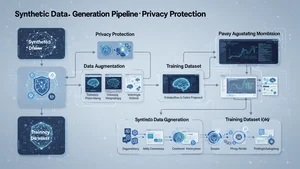
Synthetic data solves these problems elegantly. Generate privacy-safe data that looks statistically identical to real data without privacy concerns. Create unlimited examples of rare scenarios by generating them. Label automatically during generation since you control exactly what the synthetic data contains.
A financial services company I consulted for needed to train fraud detection models. Real fraud examples are rare and imbalanced. Using synthetic data, they generated balanced datasets with thousands of fraud variants. Model performance improved 34% over models trained only on real data.
The synthetic approach also let them test edge cases. What if fraud patterns shift? Generate synthetic examples of new attack vectors and test model robustness. This proactive testing caught vulnerabilities before real attacks exploited them.
How Synthetic Data Generation Works
The core techniques are generative adversarial networks (GANs), variational autoencoders (VAEs), and diffusion models. All learn patterns in real data, then generate new samples that match those patterns without copying specific records.
Modern approaches use differential privacy guarantees. The synthetic data provably doesn't leak information about specific individuals in the training set. You can share it freely without privacy concerns.
For tabular data, tools like Gretel, Mostly AI, and Tonic.ai make generation straightforward. Upload your real dataset, specify privacy requirements, generate synthetic data. The quality metrics show how well the synthetic data matches statistical properties of real data.
For images, diffusion models like Stable Diffusion or FLUX generate synthetic training data. Need 10,000 images of people wearing safety equipment? Generate them with precise control over demographics, equipment types, and scenarios.
Text data uses large language models for generation. Claude or GPT can generate realistic customer support conversations, product reviews, or business documents. Fine-tune on your real data patterns, then generate unlimited synthetic examples.
Quality and Fidelity
The question everyone asks: is synthetic data as good as real data? The answer is nuanced. For many tasks, yes. For some tasks, better. For certain applications, not yet.
Synthetic data excels at balancing datasets. Real-world data is imbalanced—fraud is rare, certain customer segments are underrepresented. Synthetic generation creates balanced datasets that train better models.
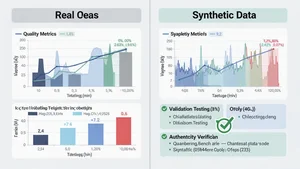
Edge case representation improves with synthetic data. Generate rare scenarios that barely exist in real data. Models trained on synthetic edge cases handle unusual situations more robustly.
Privacy is definitively better. Synthetic data eliminates re-identification risk. Share datasets with partners, researchers, or use in less secure environments without exposing real people's information.
The weakness is subtle correlations and complex relationships. Real data captures patterns we don't fully understand. Synthetic data only reproduces patterns the generator learned. For discovering unknown relationships, real data still has advantages.
Implementation Best Practices
Start with a real dataset to learn from. You need ground truth to generate high-quality synthetic data. The better your real data, the better your synthetic data.
Validate rigorously. Compare statistical properties, train models on both real and synthetic data, test on held-out real data. Ensure the synthetic data actually represents what you need.
Use hybrid approaches for best results. Combine real data with synthetic data. Use real data for common cases and overall patterns. Generate synthetic data for rare events and edge cases.
Implement privacy testing. Even synthetic data can inadvertently leak information if the generator memorized specific records. Test for privacy preservation, don't just assume it.
Use Cases That Work
Software testing benefits enormously. Generate synthetic customer data, transaction records, and usage patterns for testing. No privacy concerns, unlimited volume, perfect control over edge cases.
Healthcare and medical AI relies increasingly on synthetic patient data. Train diagnostic models without exposing protected health information. Generate rare disease examples for research.
Financial services use synthetic transaction data for fraud detection, risk models, and compliance testing. Regulatory acceptance of synthetic data has improved as validation methods matured.
Autonomous vehicles generate synthetic driving scenarios. Creating real-world examples of every possible traffic situation is impossible. Synthetic scenarios test vehicle responses to rare but critical events.
Retail and e-commerce create synthetic customer profiles for personalization testing. Validate recommendation systems and marketing strategies without using real customer data in development.
The Privacy Advantage
GDPR, CCPA, and similar regulations make using real customer data complicated. Consent requirements, right-to-deletion, data minimization—compliance is expensive and risky.
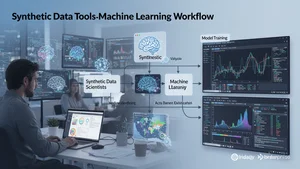
Synthetic data sidesteps most privacy regulations. It's not personal data because it doesn't relate to identifiable individuals. You can share it, store it indefinitely, and use it freely without consent requirements.
For companies operating globally, synthetic data simplifies cross-border data transfers. No sensitive data, no transfer restrictions. Development teams in any country can work with synthetic datasets.
The privacy advantage also enables AI democratization internally. Teams that couldn't access real customer data due to compliance can use synthetic data. Data science teams grow faster when everyone can access training data.
Economic Impact
Synthetic data reduces costs across the AI lifecycle. Data collection and labeling typically consume 60-80% of AI project budgets. Generating synthetic data costs a fraction of collecting and labeling real data.
A retail company reported spending $200K on labeled image datasets for product recognition. They switched to generating synthetic product images for $15K. The model trained on synthetic data performed comparably.
Time-to-market improvements are significant. Waiting months to collect sufficient real data delays projects. Generate synthetic data in days or weeks. Companies report 40-60% faster AI development cycles using synthetic data.
The cost advantages compound at scale. For companies building dozens of AI models, synthetic data infrastructure amortizes across all projects.
Challenges and Limitations
Generalization concerns remain valid. Models trained exclusively on synthetic data sometimes struggle with real-world variation. The synthetic data captures known patterns but misses unexpected real-world complexity.
Regulatory acceptance varies by industry. Healthcare and finance are increasingly comfortable with synthetic data. Other industries have less guidance on appropriate use.
Quality validation requires expertise. Determining whether synthetic data adequately represents real-world patterns isn't trivial. Bad synthetic data trains bad models.
The technology continues evolving. Best practices from 2024 are outdated in 2026. Keeping current with techniques and tools requires ongoing investment.
The Future of Synthetic Data
Adoption will reach 90%+ of AI teams by 2028. The economics and privacy benefits are too compelling. Synthetic data becomes default, real data becomes the exception requiring justification.
Quality improvements continue. Next-generation models will capture subtler patterns and complex relationships. The gap between real and synthetic data keeps narrowing.
Regulation will increasingly recognize synthetic data as privacy-preserving. More explicit guidance on appropriate use will emerge. The legal uncertainty around synthetic data is resolving favorably.
Synthetic data markets are emerging. Companies sell access to high-quality synthetic datasets for specific domains. The data industry is being disrupted by unlimited, privacy-safe synthetic alternatives.
The synthetic data revolution transforms how AI is built. Training data shifts from scarce, expensive, and restricted to abundant, cheap, and freely shareable. The bottleneck of data collection that slowed AI development for years is breaking. The companies mastering synthetic data generation will build AI faster, cheaper, and more responsibly than competitors stuck on real data alone.