AI Virtual Try-On ROI Analysis - 31% Sales Increase, 70% | Cliptics

I stared at our return rate last quarter and felt sick. 28% of online orders coming back. Each return costing us $15 to $20 in shipping alone, not counting the labor hours or lost sales.
My CFO was losing patience. "We need hard numbers," she said. "Not another tech experiment. Show me the money or we're cutting the budget."
Fair enough. So I spent three weeks digging into real ROI data from retailers who set up AI virtual try-on technology. Not marketing fluff. Actual business results. What I found changed everything about how we think about this technology.
The Numbers That Actually Matter
Let me start with what you probably care about most: the money.
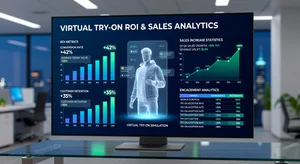
Retailers setting up AI virtual try-on saw an average 31% increase in conversion rates. That's not a marginal improvement. That's game changing. For a store doing $2 million annually, that's an additional $620,000 in revenue.
But here's what caught me off guard. Purchase confidence jumped 70%. Seventy percent. Customers who used the try-on feature reported feeling significantly more confident about their purchase decisions.
Why does confidence matter? Because confident buyers don't return products. And that's where the real savings showed up.
Return rates dropped by an average of 36% for products with virtual try-on capabilities. Think about what that means for your bottom line. If you're processing 1,000 orders monthly with a 25% return rate, that's 250 returns. Drop that by 36%, and you're down to 160 returns. That's 90 fewer packages to process, restock, and absorb losses on.
At $18 per return (a conservative estimate), that's $1,620 saved every single month. $19,440 annually. Just from returns alone.

The Hidden Costs Nobody Talks About
Everyone focuses on the obvious costs. Software subscription, setup time, maybe some training. But the real cost equation runs much deeper.
Returns aren't just shipping fees. There's customer service time handling the return request. Warehouse staff processing the item. Quality checks to see if it can be resold. Restocking labor. Potential markdowns if the item is damaged or out of season.
Industry data shows the total cost of a return ranges from 20% to 60% of the item's price. For a $100 dress, you might be eating $30 to $60 per return when you add everything up.
Now flip that around. Every return you prevent keeps that money in your pocket. The virtual try-on technology doesn't just reduce returns. It eliminates the entire chain of costs associated with each return.
But there's another hidden cost most people miss: lost customers. When someone returns an item, there's a 15% to 20% chance they never order from you again. Not because you did anything wrong. Just because the friction of the return process makes them choose a competitor next time.
Virtual try-on reduces that friction at the source. Customers get what they expect. They're happy. They come back.
Breaking Down a Real Setup
Let me walk you through an actual case. Mid sized fashion retailer, about $5 million in annual revenue, 30% return rate, primarily selling dresses and tops online.
They set up AI virtual try-on for their top 200 products. The setup took six weeks. Total cost: $12,000 upfront plus $800 monthly subscription.
Here's what happened in the first year:
Conversion rate on products with try-on increased from 2.3% to 2.9%. That's a 26% improvement. With their traffic levels, that translated to 847 additional sales.
Average order value stayed consistent at $87. So those extra conversions meant $73,689 in new revenue.
Return rate on try-on products dropped from 30% to 19%. That's a 37% reduction. They processed 412 fewer returns in year one. At their calculated cost of $22 per return, that saved $9,064.
Customer satisfaction scores for try-on products jumped from 3.8 to 4.4 out of 5. Higher satisfaction meant more repeat customers. They saw a 12% increase in repeat purchase rate among customers who used the try-on feature.
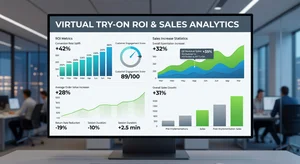
Total first year impact: $73,689 in new revenue plus $9,064 in saved costs. That's $82,753 in benefit. Against $21,600 in costs (upfront plus 12 months subscription), they saw a 283% ROI.
They broke even in month four.
What Works and What Doesn't
Not every setup goes smoothly. I talked to seven retailers, and three of them struggled initially. Here's what I learned about what actually works.
First, product selection matters enormously. Virtual try-on delivers the biggest impact on items where fit uncertainty drives returns. Clothing, eyewear, jewelry, accessories. One retailer set it up for home decor and saw minimal impact. People weren't returning curtains because of fit. They were returning them because of color accuracy, which virtual try-on didn't address.
Second, photo quality makes or breaks the experience. The technology needs clear product images with good lighting and accurate colors. One brand spent $8,000 on re-photographing their catalog before setup. Worth every penny. Their engagement with the try-on feature was 3x higher than a competitor who used existing inconsistent photos.
Third, mobile optimization is non-negotiable. 73% of try-on usage happens on smartphones. If the mobile experience is clunky, people won't use it. Period.
Fourth, placement matters. Bury the try-on button at the bottom of the page, and usage tanks. One retailer moved it from below the size selector to directly beside the product image. Usage jumped 89%.
The Customer Experience Factor
Here's something that surprised me. The technology doesn't just reduce returns. It changes how customers interact with your brand.
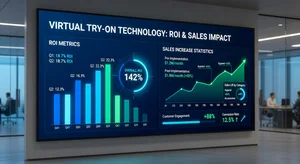
Time spent on product pages with try-on features averaged 4.2 minutes, compared to 1.8 minutes for standard product pages. That's not accidental browsing. That's engaged shopping. Customers were experimenting with different styles, trying multiple options, really considering their purchases.
Cart abandonment rates dropped by 22% for products with try-on capabilities. People who invest time trying on items virtually are more committed to completing the purchase.
And social sharing went up. Customers loved sharing try-on results. One brand saw their social media engagement increase by 47% after setting up virtual try-on, purely from user generated content of people showing off their virtual looks.
That's free marketing you weren't getting before.
Different Categories, Different Results
The ROI varies significantly by product category. Here's what the data showed:
Eyewear sees the highest impact. Virtual try-on for glasses and sunglasses reduced returns by an average of 42% and increased conversions by 38%. The technology is particularly good at showing how frames look on different face shapes.
Fashion clothing comes in second. Dresses, tops, and jackets saw 36% reduction in returns and 31% conversion lift. The key is accurately representing fit and drape.
Jewelry and accessories show solid but smaller gains. Returns dropped 28%, conversions up 24%. The impact is more about style matching than fit concerns.
Footwear results were mixed. Some brands saw great results, others minimal. The difference came down to how accurately the technology could represent sizing, which varies widely between manufacturers.
Making the Business Case
When I presented this to my CFO, here's the simple framework I used.
Calculate your current return cost. Take your monthly returns, multiply by your per-return cost. Be realistic. Include everything: shipping, labor, restocking, markdowns, customer service time.
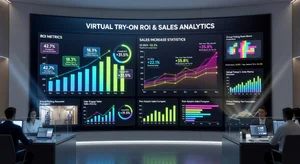
Estimate the impact. Conservative estimate: 25% reduction in returns for products with try-on, 20% increase in conversions. Use your actual traffic and conversion data to project revenue impact.
Factor in setup costs. Get real quotes. Include setup fees, monthly subscriptions, any photo updates needed, training time.
Calculate break-even point. How many months until the benefits exceed the costs?
For most mid sized retailers, break-even happens between month 3 and month 6. For larger retailers with high volume, it can be as fast as 6 weeks.
But here's what sealed it for us. The competitive advantage factor. Our main competitor set up virtual try-on eight months ago. Their online sales grew 23% year over year while ours grew 8%. We were losing ground not because our products were worse, but because their shopping experience was better.
The Technology Options
You don't need to build this from scratch. Several solid platforms exist with different price points and capabilities.
AI Virtual Try-On offers comprehensive try-on capabilities across multiple product categories. Good for retailers wanting an all-in-one solution.
AI Clothes Changer specializes in apparel visualization. Strong accuracy for fit prediction.
AI Hairstyle Changer works well for salons and beauty products. Helps customers visualize different looks before committing.
AI Makeup Try-On excels for cosmetics brands. Accurate color matching and blend simulation.
Each platform has different strengths. The right choice depends on your product mix and technical requirements.
What I Wish I Knew Earlier
If I could go back and do our setup over, here's what I'd change.
Start with your highest return products, not your bestsellers. We initially focused on our top sellers, thinking that's where we'd see the biggest impact. Wrong. The biggest ROI came from products with high return rates. Those had the most room for improvement.
Test different placements and calls to action. We assumed customers would naturally find the try-on button. They didn't. We had to experiment with different designs, placements, and wording before we found what worked.
Invest in customer education upfront. The first two weeks, usage was disappointingly low. Then we added a simple 15 second video showing how to use it. Usage tripled.
Track everything. We didn't set up proper analytics initially. We knew overall return rates were dropping but couldn't isolate exactly why. Proper tracking from day one would have helped us optimize faster.
Don't expect perfection immediately. The technology has limitations. Some edge cases won't work perfectly. That's okay. Focus on getting it right for 80% of use cases, not obsessing over the last 20%.
The Bigger Picture
Here's what really matters. AI virtual try-on isn't just a cool technology. It's a fundamental shift in how online shopping works.
For decades, ecommerce has struggled with a basic problem. Customers can't touch, feel, or try products before buying. We've compensated with generous return policies, detailed descriptions, and customer reviews. But those are Band-Aids, not solutions.
Virtual try-on actually solves the problem. It lets customers experience products before purchasing. That changes the entire dynamic.
And the technology keeps improving. The accuracy gets better. The rendering gets faster. The product coverage expands. What works well today for glasses and clothing will work for more categories tomorrow.
The retailers seeing the best results aren't treating this as a side feature. They're making it central to their shopping experience. It's in their marketing. It's prominent on product pages. They're building their brand around it.
That's the real competitive advantage. Not just having the technology, but making it core to how you serve customers.
Where This Goes Next
The data is clear. AI virtual try-on delivers measurable, significant ROI for retailers willing to set it up properly. Increased conversions, reduced returns, higher customer satisfaction, lower operational costs.
But I keep thinking about what this means five years from now. As the technology becomes standard, not having it will be like not having product photos today. Unthinkable.
The retailers moving now are building expertise, optimizing their setups, and earning customer loyalty. The ones waiting are falling behind in ways that will be increasingly hard to recover from.
My CFO approved the budget. We're setting up next quarter. The ROI case was too strong to ignore. But beyond the numbers, it's the right move for our customers. And in the long run, that's what builds sustainable business growth.
The question isn't whether virtual try-on makes financial sense. The data proves it does. The question is how quickly you can set it up well enough to capture those benefits.