
How to Use AI Voice to Make Shorts Go Viral (YouTube + | Cliptics
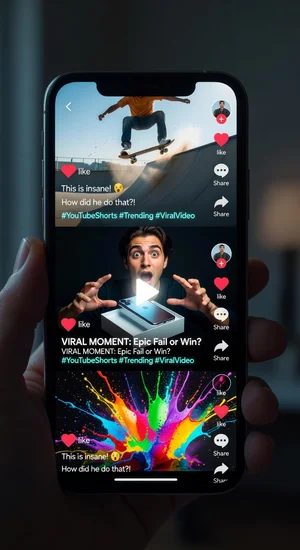
Short-form video is genuinely strange if you think about it. A creator with 300 subscribers posts a 45-second clip and it hits 2 million views. Another creator with 100,000 subscribers posts something and it flatlines. The algorithm doesn't care about your follower count nearly as much as it cares about whether people watch the whole thing, share it, and come back for more.
AI voice is becoming a legitimate part of the strategy for shorts that perform. Not just for faceless channels, though those exist and thrive. But also for established creators who want to produce more without burning out their voice on every clip. Here's what actually works.
Why Voice Matters in Shorts
You might assume that in a visual format like Shorts or Reels, the voice is secondary. That's not quite right. The voice sets pace, creates urgency, and drives watch time in ways that visuals alone don't.
Think about how you interact with short videos. When you're scrolling, you're making a decision in the first two or three seconds: does this feel worth continuing? A voice that starts with immediate value, not a slow intro, not "hey guys welcome back," but right into the interesting thing, signals to your brain that the next 40 seconds will be worth your time.
AI voice gives you complete control over this. You write the hook exactly how you want it. You can test different openings without recording 15 takes. And you can do this for every single video without burning out.
The Hook Is Everything
For Shorts and Reels, the first three seconds determine whether the rest of the video matters. Your hook has one job: make the viewer curious enough to not swipe.
The hooks that consistently work are: surprising facts ("most people have no idea that..."), contrarian statements ("everyone says X but actually Y"), and direct curiosity gaps ("here's what happens when you...").
Write your hook first, separate from the rest of the script. Generate just the hook with your AI voice and listen. Does it have energy? Does it make you want to know what comes next? If not, rewrite it before continuing.
Cliptics Text to Speech lets you generate short test clips quickly without committing to a full script. This is useful for testing different hook approaches before locking in.
Choosing Your Voice for Short-Form Content
Not every TTS voice works for short-form video. The ideal voice for Shorts has specific characteristics:
It needs energy without sounding manic. Slow, measured voices that work for podcasts and educational content feel sleepy in a format where everything is moving fast.
It needs clarity at faster speeds. Most successful Short creators pace their narration faster than conversational speech. You're compressing information into a tight timeframe. The voice needs to still be intelligible at 1.1x or 1.2x the default rate.
It needs natural-sounding emphasis. The key words in each sentence should get slight emphasis naturally. If every word sounds the same volume and stress, the narration becomes a wall of sound.
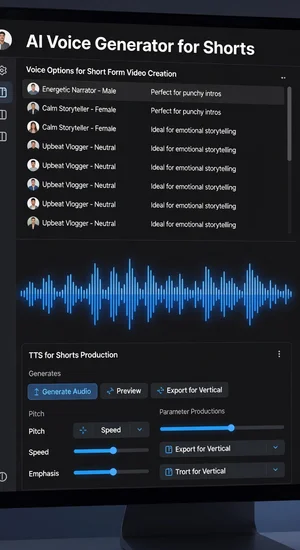
Cliptics AI text to speech free tool has multiple voice options worth testing. Generate the same 30-second script with three different voices and listen at normal speed and then slightly faster. The one that still sounds natural and clear at a faster rate is your voice for Shorts.
Script Structure That Drives Watch Time
Every high-watch-time Short has a structure, whether the creator planned it or not:
Hook (0-3 seconds): The thing that makes them stop scrolling.
Setup (3-10 seconds): Context that makes them invested in the payoff.
Payoff progression (10-35 seconds): The actual valuable content, but broken into micro-beats. Not one revelation, but three or four smaller ones that keep them watching.
Call to action or loop (35-45 seconds): Either tell them what to do next ("follow for more") or create a loop where the end connects back to the beginning ("remember that thing I said at the start? here's why it matters").
Write your script to this structure consciously. Generate it as voice, listen back, and time each section. If your setup is running 20 seconds, you've lost most of your audience before they get to the good part. Cut it.
Pacing and the Silence Problem
One thing AI voice does wrong by default in most tools is silence. Natural speech has micro-pauses. Not long pauses, not dramatic silences, just tiny half-second gaps between ideas. Many TTS tools remove these or treat all pauses the same length.
You can control this through punctuation. A period creates a brief pause. An ellipsis in many tools creates a longer one. Splitting a thought into two sentences instead of one with a comma creates more natural rhythm.
For Shorts specifically, you want minimal dead air. Every second of silence in a 45-second video is a percentage point of watch time. Read through your generated audio and note anywhere it feels slow. Tighten the script to remove it.
Using Multiple Voices for Retention
Here's a tactic that genuinely works: using two different voices within a single Short to signal transitions between ideas. It's almost like a conversation between two characters even when the content is a monologue.
Cliptics multi-speaker text to speech handles this well. You can designate different voices for different parts of the script. The voice shift is a pattern interruption. Pattern interruption is one of the most powerful retention tools in short-form video because our brains are wired to pay attention when something changes.
Even something subtle, like using Voice A for the setup and Voice B for the payoff delivery, creates a beat change that keeps people watching through transitions.
The Volume Play
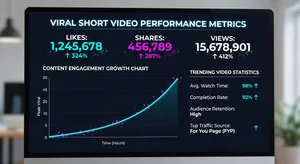
Consistency drives algorithmic growth in short-form more than any individual viral hit. One video going viral doesn't sustain a channel. A steady cadence of 20 to 30 videos per month that each perform decently eventually produces your viral moments as a natural outcome of volume.
AI voice enables this cadence because the time bottleneck for producing Shorts is usually not the visual production, it's the scripting and recording. With TTS, you eliminate the recording step entirely. Write a script in 20 minutes, generate the voice in two minutes, assemble the video in 15 minutes. That's a 37-minute Short. Do that five days a week and you have 20 videos per month.
At that volume, you're going to find out what works. The algorithm rewards consistency. So does audience growth. The creators who've built substantial Short-form followings in the past year aren't necessarily creating better content than you, they're creating more of it more consistently. AI voice tools are a significant enabler of that.