AI vs Human Voiceover for Corporate Training Videos: Cost | Cliptics
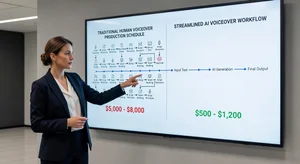
The L&D team at a mid-size manufacturing company spent $47,000 on professional voiceover for their annual compliance training library in 2023. The same training content, updated and rebuilt with AI voiceover in 2024, cost $1,200 in tool access and internal time. Both versions passed their required content audits. Both achieved similar completion and quiz score metrics.
That's not an anomaly. It's an early signal of a structural shift in how organizations approach training content production. For L&D leaders trying to do more with constrained budgets, the AI voiceover calculus in 2026 is worth understanding precisely rather than by assumption.
The True Cost of Human Voiceover
The visible cost of professional voiceover is the per-finished-hour rate: typically $200-500 per finished hour of audio from a professional narrator, depending on their market tier and usage rights.
But the finished-hour rate understates the real cost by 40-60% in most corporate training contexts. The full cost accounting includes:
Script-to-delivery timeline: professional narrators typically need 5-7 business days from final script to delivered audio. For quarterly or monthly content updates, this timeline becomes a production bottleneck. Rush fees for faster delivery add 50-100% to the base rate.
Revision costs: most professional voiceover contracts include one revision round in the base rate, with additional rounds billed at an hourly rate. Training content frequently requires multiple revisions because compliance language changes after initial recording, stakeholder reviews identify needed changes, and technical review catches errors. Average revision costs add 15-25% to the base rate for most corporate training projects.
Project management time: coordinating with voice talent, approving takes, managing revision cycles, and processing final deliverables is typically 4-8 internal hours per training module. At average L&D professional hourly cost, this adds $200-600 per module.
For a 20-module training library with average 15 minutes finished audio each, total production cost including revisions and project management is typically $35,000-65,000, not $15,000-25,000 that the per-hour rate alone would suggest.
The AI Voiceover Cost Structure
Cliptics Text-to-Speech and Cliptics AI Multi-Voice Text-to-Speech represent the free tier of AI voiceover tools. For larger-scale production with specific enterprise requirements, paid AI TTS platforms offer additional voices and API access.
For a 20-module training library equivalent:
AI tool cost: $0-$200 per month depending on volume tier. Script preparation time: unchanged from human voiceover workflow. Audio generation time: 5 minutes per 15-minute module (real-time or faster generation), versus 5-7 days. Revision time: immediate regeneration from updated script text, typically under 10 minutes per module versus 2-5 days. Project management time: 1-2 hours per module (reduced from 4-8 because coordination with external talent is eliminated).
Total production cost for same 20-module library: $2,000-5,000 including internal time, tool costs, and revision cycles.
Where the Quality Comparison Actually Stands
The honest quality assessment for corporate training voiceover in 2026: AI narration has crossed the threshold for most training content categories. It has not crossed the threshold for all of them.
Content where AI voiceover performs equivalently to competent professional narration:
- Procedural training: step-by-step processes, software tutorials, compliance procedures
- Informational content: policy explanations, benefit overviews, regulatory updates
- Assessment and quiz audio: straightforward question and answer narration
- e-Learning modules with primarily visual content supplemented by narration
Content where human narration still has meaningful quality advantages:
- Executive communications and leadership development content where personal presence is part of the message
- Content requiring genuine emotional nuance: sensitive topics, empathy-forward communication training, mental health content
- Brand-defining content intended to represent the organization to external audiences (customer training, partner onboarding where the voice represents your brand externally)
- Content requiring improvisation or unscripted authenticity
For most internal compliance, skills, and operational training, the first category covers the majority of content.
The ROI Calculator
To apply this to your specific situation, use this framework:
Annual voiceover cost (A): total spend on voice talent, studio time, revisions, and project management for your current training library.
AI voiceover cost (B): tool subscription cost plus internal time at your L&D team's fully-loaded hourly rate, for equivalent content volume.
Quality adjustment (C): for content in the second category above, estimate the percentage of your annual production volume that genuinely requires human narration. Keep this as human voiceover.
Annual savings = (A × (1-C)) - (B × (1-C))
For most organizations, C is 10-25% of total voiceover content. The savings on the 75-90% of content appropriately served by AI narration is substantial regardless of your current spend level.
Setup Approach for L&D Teams
The transition that works most cleanly: don't replace your entire voice talent relationship immediately. Run a parallel pilot.
Select three modules from your current production queue that represent your bread-and-butter training content (not your most sensitive or brand-forward content). Produce them with AI voiceover and run a quality comparison review with an internal panel. Assess for:
- Clarity and comprehension
- Pronunciation accuracy for industry-specific terms
- Appropriate pacing for the content type
- Learner acceptance in a small test group
Most organizations who run this pilot find that the content meets or exceeds their internal quality standard for the test category. The learner acceptance data is typically the most influential for decision-makers: learners who aren't told the content was AI-narrated generally don't identify it.
The Rapid Update Advantage
Beyond the cost difference, the operational advantage that L&D teams find most valuable in practice is update speed. Regulatory change, product update, or policy revision that requires training content modification can be addressed in hours rather than weeks.
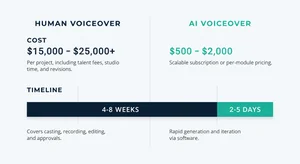
The traditional workflow for a compliance training update: update script, schedule with voice talent, wait 5-7 days for recording, receive and review, request revisions, wait for revisions, integrate audio, QA test, redeploy. Realistic timeline: 3-4 weeks minimum.
The AI voiceover workflow: update script, regenerate audio (10 minutes), integrate into updated module, QA test, redeploy. Realistic timeline: same day or next day.
For organizations in regulated industries where training currency is a compliance requirement, not just a quality preference, this speed difference has direct risk management implications.
The Recommendation for 2026
For L&D teams producing more than 20 hours of narrated training content annually: evaluate AI voiceover for your procedural, informational, and compliance content categories. The quality threshold has been met, the cost difference is significant, and the operational flexibility advantages compound over time.
Maintain human narration relationships for your externally-facing content, your leadership development programming, and content categories where human presence is part of the learning experience.
The decision isn't binary. The organizations capturing the most value from AI voiceover are using it selectively for appropriate content while being intentional about preserving human narration where it delivers differential value.
That selectivity is the strategic judgment that the cost numbers alone don't provide. The cost analysis tells you the savings are real. Your content catalog tells you where to apply them.