
Audio Translation vs Subtitles: What Actually Performs | Cliptics
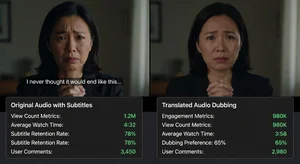
If you're publishing video content to international audiences, you've made a translation decision whether you know it or not. Subtitles, dubbed audio, auto-generated captions, or nothing: each choice produces measurably different audience behavior. The data from 2025-2026 gives us the clearest picture yet of what actually performs better in specific contexts.
The answer isn't universal. It depends on content type, platform, target market, and the quality of the translation execution. Here's the evidence-based framework.
The Baseline Performance Data
Recent platform-level research across YouTube, Instagram, and LinkedIn surfaces consistent patterns:
Completion rate: dubbed audio averages 8-12% higher completion rates than subtitled content for videos longer than 90 seconds. For short-form content under 60 seconds, the difference is negligible. The gap widens with content length.
Engagement rate: subtitled content generates higher comment engagement than dubbed content in most markets, likely because subtitles preserve the original speaker's authentic voice and personality, which drives stronger audience connection and reaction.
Conversion rate (for content with a CTA): dubbed content converts at 6-9% higher rates than subtitled equivalent content in markets where dubbed content is the cultural norm (Latin America, Germany, France). In markets where subtitles are preferred (Netherlands, Portugal, Nordic countries), subtitled content converts better.
Share rate: subtitled content is shared more frequently, particularly in languages where the audience's English proficiency is high enough that they can engage with the original audio while reading the translation.
The Cultural Norm Factor
The performance difference between dubbed and subtitled content isn't primarily about content quality. It's about audience expectation formed by media consumption history.
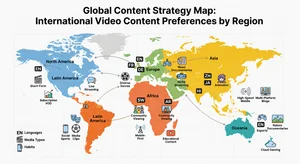
Germany, France, Italy, and Spanish-speaking Latin America have cultural traditions of professional dubbing for international film and television. Audiences in these markets have been trained to expect localized audio and often find subtitled foreign-language content more demanding to watch than dubbed content.
Netherlands, Scandinavia, Portugal, and most of Asia (outside Japan, Korea, and China) have subtitle-dominant traditions. Audiences are comfortable reading subtitles and, in many cases, prefer the authenticity of hearing the original audio.
Japan, Korea, and China present a specific case: dubbing is standard for long-form content, but both subtitled and dubbed short-form content performs well depending on the content type and creator context.
Before choosing a format, research your target market's established media consumption patterns. Aligning with audience expectation is worth more than marginal quality differences between production approaches.
When Subtitles Win
Subtitles are the right choice when:
Your original speaker is the primary value proposition. Thought leaders, educators, and personality-driven creators communicate something in their original voice that dubbing can't fully preserve. International audiences who follow your content for you, specifically, tend to prefer hearing your voice with translation assistance.
Production speed and budget constrain audio dubbing. High-quality dubbed audio requires professional voice actors in the target language, quality control, audio engineering, and time. Subtitles can be produced quickly and updated easily. For content with short shelf life (news, commentary, trend-response content), subtitles are often the only practical option.
Your target market has high source-language proficiency. In markets where substantial portions of your audience are proficient in your original language, subtitles serve as comprehension support rather than complete language replacement. Keeping the original audio maintains the authenticity and connection signals while the subtitles assist comprehension.
The content is short-form with primarily visual information. For content under 60 seconds where the visual is doing most of the communicating, subtitles add translation value without the completion-rate cost that subtitles incur on longer content.
When Dubbed Audio Wins
Audio dubbing delivers better performance when:
You're targeting markets with dubbing cultural norms. For German, French, Spanish, and Italian language markets, dubbed content that meets quality expectations performs significantly better than subtitled equivalents on every metric except comment engagement.
Your content is long-form and information-dense. For educational content, corporate training, webinars, and any video where audience comprehension is the primary success metric, dubbed audio removes the comprehension overhead of reading while listening in a second language. Retention and assessment performance in training contexts is measurably higher for dubbed content.
You're distributing on platforms where subtitles are less effective. On platforms where the viewing context is frequently mobile and commuting, where viewers can't easily read subtitles (driving, gym, crowded transit), dubbed audio maintains accessibility where subtitles fail.
The content will be used over an extended period. Dubbed content has a higher upfront production cost but that cost amortizes over the content's use life. For content that will be used for 12-24 months (onboarding videos, product tutorials, brand story content), the ROI calculation often favors dubbing.
The Quality Threshold That Determines Both
Poor subtitles and poor dubbing both perform worse than each other done well. The quality benchmark matters more than the format choice in many contexts.
For subtitles, quality failures that most damage performance: poor timing synchronization (text that appears out of sync with the speech), machine translation quality insufficient for the content's complexity, and text that appears faster than a comfortable reading pace.
For dubbed audio, quality failures: voice actors who don't match the original speaker's apparent demographic or authority profile, audio timing that doesn't match mouth movements in recognizable ways, and translation that preserves words but loses meaning or nuance.
Both failures are avoidable. Both require quality investment appropriate to the content's strategic importance.
The Hybrid Approach
The most sophisticated international content strategy in 2026 uses both, selectively. Subtitles for content released quickly and content in subtitle-norm markets. Dubbed audio for your highest-value content in dubbing-norm markets.
This isn't choosing one over the other. It's recognizing that format choice is a market and content-type decision rather than a singular strategic choice.
For creators and brands beginning their international distribution journey, start with subtitles for breadth and build toward dubbed audio for your highest-priority markets as you develop audience data about where your content performs and who your international audience actually is. Let performance data from subtitled content identify your most valuable international markets, then invest in dubbed audio for those specific markets.
The goal isn't to produce the cheapest international version of your content. It's to produce the version that your international audience will actually engage with at the depth that drives your content goals. Format is one input to that decision. The others are budget, content type, market, and time investment. Getting the combination right is the edge.