Best Hashtags for E-Commerce Product Launches | Cliptics
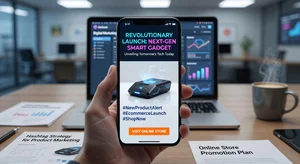
Launching a new product on social media is one of those moments where everything you do in the first 24 to 48 hours matters. Early engagement signals that your launch is performing well. Algorithms amplify content that gets early traction. And the hashtag choices you make determine which communities even see the launch post.
Most e-commerce marketers default to generic hashtags. #newproduct, #shopnow, #onlineshopping. These tags have hundreds of millions of posts. Your launch gets buried in seconds. The smarter move is targeting the specific communities most likely to care about your specific product.
Here's how to build a hashtag strategy for product launches that actually reaches potential buyers.
The Product Launch Hashtag Framework
For a product launch, you want hashtags that serve two different audiences simultaneously: people who might buy and people in the commerce/creator community who might amplify.
Buyer-intent hashtags: These describe the product and connect you with people who are actively looking for that type of item. For a yoga mat launch: #yogamat, #ecoyoga, #homeyyogastudio, #yogaaccessories. For a skincare launch: #naturalskincare, #cleanbeauty, #skincareaddict, #glowupproducts.
Commerce community hashtags: These connect you with other entrepreneurs, product photographers, and e-commerce communities who follow launches, share finds, and create the social proof of others noticing your product. #productphotography, #smallbusiness2026, #shopsmall, #ecommerce, #productlaunch, #newbrand.
Category and lifestyle hashtags: These reach the lifestyle communities that surround your product without being product-specific. A sustainable clothing brand benefits from #sustainablefashion and #slowfashion. A fitness equipment brand benefits from #homegym and #fitnessgear.
The combination of all three in a launch post serves multiple discovery channels at once.
Using AI Tools to Find Launch Hashtags
Cliptics AI hashtag generator works well for e-commerce launches because you can input specific product descriptions and get category-relevant suggestions you might not think of manually. Type "handmade ceramic coffee mugs" and you'll get more targeted results than searching generic "ecommerce hashtags."
The Instagram hashtag generator on Cliptics is worth using for Instagram-specific launch content, and Cliptics Facebook hashtag generator if you're running Facebook alongside Instagram (which most e-commerce brands do).
The free hashtag generator gives you a starting set to work from, which you can then customize based on your specific product niche.
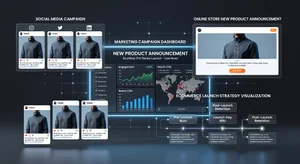
Platform-Specific Launch Hashtag Strategies
Instagram: Your launch post should use 10 to 15 hashtags. Include one to two product category tags, three to four buyer-intent niche tags, three to four commerce community tags, and three to four lifestyle community tags. If you've built any brand-specific hashtags (like a branded hashtag for your shop or a campaign hashtag), include those.
Stories and Reels for the launch should use the same hashtag strategy but you can include them via the hashtag sticker in Stories rather than in the caption.
Facebook: Hashtags work differently on Facebook. Using two to three highly relevant hashtags is more effective than the longer sets that work on Instagram. Facebook's algorithm doesn't distribute content through hashtag feeds the way Instagram does, so hashtags here function more as grouping signals. Focus on your two most specific and relevant category tags.
TikTok: If your product launch includes a TikTok, use three to five hashtags. For launches specifically, challenge hashtags that encourage other users to interact with the product concept can be powerful. Think about what behavior you could encourage around your product launch that would make a good challenge format.
Timing Your Launch Content
The hashtag strategy pairs with a specific content timing approach for product launches.
Launch teaser content before the launch date using the hashtags early. This seeds your presence in those hashtag feeds before the launch. Some potential customers may see the teaser, follow you, and engage with the launch post when it comes. This early engagement signal benefits the launch post's algorithmic reach.
Launch day content should be your strongest visual and clearest call to action. Product photography against a clean background (where tools like Cliptics background remover are useful for creating those clean product images) makes launch content look professional. Use your full hashtag set.
Post-launch content (days two through five) keeps the product visible without constant launch messaging. Behind-the-scenes, lifestyle uses, customer reactions, and product detail shots all keep the hashtags active and extend the launch window.
Building a Branded Hashtag for Long-Term Brand Growth
The product launch is a good moment to introduce a branded hashtag if you don't have one yet. A branded hashtag is specific to your business and encourages customers to tag their purchases.
Keep it short, specific enough to be unique, and memorable. #YourBrandShop or a phrase specific to your brand voice. Include it in every post, on packaging, and encourage customers to use it when sharing their purchases.
Over time, a branded hashtag becomes user-generated content. Customers tagging their orders with your hashtag creates social proof that appears in the hashtag feed and reaches their followers. This organic word-of-mouth through hashtag amplification is some of the highest-quality social proof available.
Measuring Launch Hashtag Performance
After your launch window (roughly the first week), review your post analytics. On Instagram, look at the reach from hashtags versus reach from home feed and Explore. If hashtag reach was significant, your set was working. If it was minimal, either your content wasn't getting traction in those feeds or the hashtag selection wasn't reaching the right people.
For future launches, test different hashtag combinations and compare results. The e-commerce brands that consistently grow their social presence treat hashtag selection as something to test and optimize over time rather than set-and-forget.
The combination of good AI hashtag tools, thoughtful product launch timing, and strong visual content gives your product launch the best chance of reaching real potential buyers rather than just disappearing into the feed noise.