Decentralized Social Media Platforms 2026: Mastodon | Cliptics
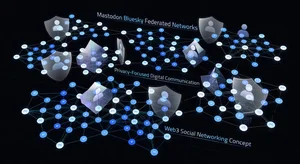
The centralized social media model has a structural problem that became impossible to ignore over the past several years. A small number of companies control the social graphs, the content algorithms, the data, and ultimately the attention of billions of people. When any of these companies changes its policies, adjusts its algorithm, or experiences a governance crisis, the ripple effects reach everyone on the platform simultaneously with no alternative.
Decentralized social media proposes a different architecture: networks where no single company controls the platform, where your account is portable across different servers, and where the data stays in your hands rather than in corporate databases.
In 2026, these platforms have moved from fringe alternatives to legitimate competitors with millions of active users. This is a guide to what they are, how they work, and how to decide if they are right for you.
The Core Architecture Difference
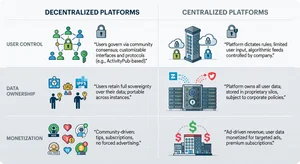
Traditional social media (Twitter/X, Facebook, Instagram, TikTok) is built on centralized servers owned and controlled by a single company. Your account, followers, posts, and data exist on those servers and nowhere else. The company sets the rules. If you violate them, your account disappears. If the company closes, your social graph disappears with it.
Federated social media works more like email. Email is not controlled by any single company. A Gmail user can email a Yahoo user can email a Microsoft 365 user. Different servers, different operators, same protocol.
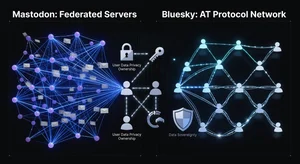
Mastodon, the largest federated social network, uses the ActivityPub protocol. Thousands of independent servers (called instances) each run their own community with their own rules, but they can communicate with each other through the shared protocol. Your Mastodon account on one server can follow and interact with accounts on any other server in the network (called the Fediverse).
Bluesky uses the AT Protocol, developed by Jack Dorsey's team after leaving Twitter. It takes a similar federated approach but with a different architecture that allows more portability of social graphs.
Mastodon: The Largest Federated Network
Mastodon has been growing steadily since 2016 but saw explosive growth during periods of instability at Twitter/X. As of 2026, it hosts over 12 million active accounts across thousands of servers.
How to join Mastodon: Unlike Twitter, there is no single Mastodon signup page. You join a specific instance. The instance you join sets the community tone and moderation rules, but you can interact with anyone across all other Mastodon instances.
Popular instances:
- mastodon.social: The largest general-purpose instance, run by the Mastodon nonprofit
- fosstodon.org: Free and open source software community
- hachyderm.io: Tech industry professionals
- journalism.social: Journalists and media professionals
- scholar.social: Academic researchers
You can migrate your account to a different instance at any time if you decide your initial choice does not fit, and your followers transfer with you.
What Mastodon feels like: More like early Twitter. Text-forward, conversational, with a culture that values thoughtful engagement over viral reach. The algorithmic feed manipulation that drives engagement (and outrage) on mainstream platforms is absent. You see posts from people you follow in chronological order.
Limitations: Discovery is harder than on centralized platforms. There is no global trending content algorithm pushing popular posts to everyone. Cross-instance search has limitations. The userbase, while growing, is smaller than mainstream platforms.
Bluesky: The AT Protocol Approach
Bluesky was founded by Twitter co-founder Jack Dorsey and launched from invite-only to public access in 2024. It takes a different technical approach than Mastodon while sharing the goal of user data portability and reduced central control.
Key differences from Mastodon:
- Bluesky.app is a single entry point (though federation allows others)
- Custom algorithmic feeds that users can choose from or create themselves
- Better content discovery through its algorithmic options
- More familiar interface for Twitter/X refugees
User growth: Bluesky grew from 1 million to over 30 million users between late 2023 and early 2025, driven by Twitter/X policy changes. In 2026 it hosts one of the most active alternative social media communities.
Who uses Bluesky: Journalists, academics, creative professionals, and tech workers have migrated to Bluesky in significant numbers. The platform has developed a reputation for quality discourse and a lower-toxicity environment than mainstream alternatives.
Nostr and Other Protocols
Beyond Mastodon and Bluesky, the decentralized social media space includes several other approaches.
Nostr: A cryptography-based protocol where identity is tied to a cryptographic key pair rather than a server. More censorship-resistant than Mastodon or Bluesky because there is genuinely no central point of control. Smaller community but actively developing.
Pixelfed: A federated Instagram alternative using the ActivityPub protocol. Photo-sharing focused, compatible with Mastodon so Mastodon users can follow Pixelfed accounts directly.
PeerTube: Federated video hosting, a decentralized alternative to YouTube. Content creators can host videos on their own instances without platform dependency.

Privacy Comparison: Centralized vs Decentralized
Privacy is often cited as a primary reason for migrating to decentralized platforms. The comparison is nuanced.
Data collection: Centralized platforms collect detailed behavioral data and use it for advertising targeting. The economic model depends on it. Decentralized platforms typically collect minimal data, and the data that does exist is distributed across many independent operators rather than centralized in a single corporate database.
Advertising: Most decentralized platforms do not have advertising business models. Mastodon instances are typically funded by donations or small subscription fees. The absence of advertising removes the incentive for extensive behavioral data collection.
Content permanence: This is counterintuitive: content on decentralized platforms can be harder to delete than content on centralized ones. When a post has been federated to hundreds of servers, deletion requests have to propagate to all of them, and not all instances comply promptly. Think carefully about anything you post.
Server operator trust: On centralized platforms, you trust one large corporation. On federated platforms, you trust whoever runs your specific instance. For most users, this is actually a smaller, more accountable operator.
Encryption: Most decentralized social media does not offer end-to-end encryption for direct messages by default. For truly private communications, Signal or similar encrypted messaging apps remain the better choice.
The Practical Migration Guide
If you want to establish a presence on decentralized platforms, here is a practical approach.
Do not delete your centralized accounts. Your existing audience is on those platforms. Start by cross-posting to decentralized platforms and build your presence there gradually. Most decentralized communities are skeptical of new users who announce they are quitting mainstream platforms and then disappear when the process proves harder than expected.
Choose the right instance for Mastodon. Browse instances.social to find communities organized around your interests. A smaller topical instance often has better community moderation than very large general-purpose instances.
Experiment with Bluesky first if you want a gentler transition. The interface is more familiar to Twitter users and content discovery is easier. It is a reasonable first step into federated social media.
Import your existing follows where possible. Tools like Movetodon and Fedifinder help identify which of your Twitter/X connections have Mastodon accounts so you can follow them there.
Adjust expectations for growth. Building an audience on decentralized platforms takes longer than on algorithmic platforms because there is no viral amplification mechanism. Consistent posting and genuine engagement over months builds real, durable connections.
Is Decentralized Social Media Right for You?
Decentralized platforms are not better in every dimension. They involve real tradeoffs.
They are better for: privacy from corporate data collection, community control of moderation, resistance to platform-level policy changes, and chronological content without algorithmic manipulation.
They are worse for: audience reach (smaller total user base), content discovery (no algorithmic amplification of popular content), features (many mainstream platform features do not exist or work differently), and simplicity (the concept of choosing an instance is genuinely confusing to new users).
The most pragmatic approach in 2026 is to maintain presence on mainstream platforms for audience reach while building genuine community on decentralized alternatives. The two approaches are not mutually exclusive.
The shift toward decentralized social media is gradual but structurally motivated. Every major policy change on centralized platforms accelerates it. The infrastructure is now mature enough that the migration, for those who choose it, is practical rather than experimental.