
DeepSeek R1: Matching GPT-5 at 27x Lower Cost | Cliptics

Something genuinely wild happened in the AI world and most people barely noticed. A Chinese lab called DeepSeek released a reasoning model that goes toe to toe with OpenAI's best on math and coding benchmarks. The catch? It costs roughly 27 times less to run.
Not a typo. Twenty seven times.
I've been following AI pricing closely because, frankly, it affects everything. The tools we build, the features we can offer, who gets access to what. And when DeepSeek R1 showed up with benchmark scores rivaling o1 and GPT-5 at a fraction of the price, it felt like one of those moments that actually shifts things.
What Makes DeepSeek R1 Different
Let's talk numbers first. DeepSeek R1 packs 671 billion parameters into a Mixture of Experts (MoE) architecture. That sounds massive, and it is. But here's the clever bit: only 37 billion parameters activate per query. The model routes each request to whichever expert networks are most relevant, so you get the intelligence of a 671B model without the computational overhead of running the whole thing every single time.
The training is equally interesting. DeepSeek used a four stage pipeline. Cold start with chain of thought examples. Reasoning focused reinforcement learning. Supervised fine tuning on mixed data. Then a second round of reinforcement learning for general helpfulness. That last step is what keeps it from being a one trick pony. It can reason deeply when needed and still carry on a normal conversation when that's what you want.
On benchmarks, the results speak for themselves. R1 hits 97.3% on MATH 500 and around 79.8% on AIME, which is the American Invitational Mathematics Examination. It scores a 2,029 Elo rating on competitive coding tasks. These numbers put it squarely in the same league as OpenAI's o1. In some areas, it pulls ahead.

The Price Gap Is Almost Absurd
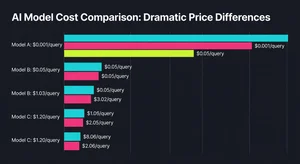
Here's where it gets really interesting. DeepSeek R1 costs $0.55 per million input tokens and $2.19 per million output tokens through their API. Compare that to OpenAI's equivalent reasoning models, which run anywhere from $15 to $60 per million output tokens depending on the tier.
To put that in real terms: a workload that costs you $100 on OpenAI's o1 API runs about $3.60 on DeepSeek R1. Same type of reasoning task. Same quality of output. Ninety six percent cheaper.
And if your prompts share a common prefix (which they often do in production systems), cached input tokens drop to $0.14 per million. That's another huge saving that adds up fast when you're processing thousands of requests.
This isn't just about saving money for developers. It changes what's possible. Startups that couldn't afford frontier model reasoning can now build products around it. Researchers who were rationing API calls can run experiments freely. Students and hobbyists get access to capabilities that were locked behind enterprise budgets six months ago.
Open Source Changes the Game
Maybe the most important part of this story is that DeepSeek R1 is fully open source under the MIT license. You can download the weights, run it locally, fine tune it, build commercial products on top of it. No restrictions worth worrying about.
They also released six distilled versions ranging from 1.5 billion to 70 billion parameters. These smaller models were trained on 800,000 synthetic reasoning examples generated by the full R1. And here's something that still surprises me: the 1.5B distilled version outperforms GPT-4o on AIME and MATH 500. A model small enough to run on a decent laptop beats what was the world's best AI a year ago on math benchmarks.
The open source approach has already spawned an ecosystem. You can find DeepSeek R1 on Hugging Face, run it through various cloud providers like Fireworks and Together, or host it yourself if you have the hardware. Competition among hosting providers has driven prices even lower than DeepSeek's own API in some cases.
For anyone building AI powered creative tools (like the ones we work on at Cliptics, including our AI Image Generator), this kind of price collapse in reasoning capabilities opens up features that would have been prohibitively expensive before. Complex image analysis, multi step creative workflows, intelligent content suggestions. All suddenly within reach.
Where GPT-5 Still Wins
I want to be honest here because I think overselling DeepSeek would be a disservice. GPT-5 is still the more complete package for many use cases.
OpenAI's models handle multimodal tasks better. Image understanding, voice input, real time web access, tool use. The overall polish and reliability is ahead, especially for production deployments where consistency matters more than raw benchmark scores. GPT-5 also tends to be faster on typical queries, which matters when you're building user facing products where every second counts.
DeepSeek R1 shines specifically on reasoning heavy tasks. Math, logic, coding, structured analysis. If your use case is centered around these, you'd be overpaying significantly with GPT-5. But if you need a model that does everything reasonably well across all modalities, OpenAI still has the edge.
The newer DeepSeek V3.2 model narrows this gap further, adding sparse attention mechanisms and approaching GPT-5 level performance on general tasks. The trajectory is clear even if the destination isn't fully reached yet.
What This Means Going Forward
We're watching AI pricing follow a pattern that mirrors what happened with cloud computing, smartphones, and internet access. Capabilities that start as premium luxuries get democratized rapidly once competition enters the picture.
DeepSeek R1 is part of a broader wave. Meta's Llama models, Mistral, Qwen, and others are all pushing the open source frontier. The result is that the gap between the best closed model and the best open model keeps shrinking. Not disappearing, but shrinking.
For anyone working with AI tools, whether you're creating content with something like our AI Video Generator or building your own applications, the practical takeaway is simple. You have more options now than ever. And those options are getting cheaper and more capable every few months.
The real question isn't whether DeepSeek R1 is better than GPT-5. They serve different needs at different price points. The real question is what you're going to build now that frontier level reasoning costs almost nothing. That's the part worth getting excited about.