
How AI Is Changing Photography Forever | Cliptics
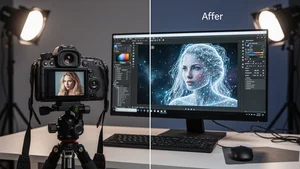
I've been a working photographer for over a decade. Weddings, portraits, product work, the full range. And I'll be honest with you: the last two years have changed more about how I shoot and edit than the previous eight combined.
AI didn't just arrive in photography. It crashed through the door, rearranged the furniture, and now it's asking if we'd like to stay. Some photographers are panicking. Others are pretending it doesn't matter. Both responses are wrong.
Here's what's actually happening, what it means for your work, and how to think about all of this without losing your mind.
The Camera Itself Has Changed
Let's start with something most people don't realize. Your phone camera has been using AI for years. Computational photography, the process of using software to enhance images at the moment of capture, is not new. But the scale of it in 2026 is staggering.
Google's latest Pixel phones are running real-time scene segmentation. The camera identifies the sky, the subject, the foreground, and processes each region differently in the same exposure. Apple's Deep Fusion has evolved to handle motion and low light in ways that would have required a tripod and bracketing just five years ago.
The result? A phone in your pocket can now produce images that compete with mid-range DSLRs in most conditions. Not all conditions. Not in every way. But for the average viewer scrolling through social media, the difference has practically vanished.
This isn't theoretical. I've shown phone photos alongside images from my Canon R5 to non-photographers and they genuinely cannot tell which is which. That should make every working photographer sit up and pay attention.
AI Editing Is Where Things Get Serious
Shooting is one thing. Post-processing is where AI has completely rewritten the playbook.
Adobe Lightroom's AI masking tools can now detect and separately adjust the sky, subject, background, clothing, and specific facial features in a single click. What used to take twenty minutes of careful brush work happens instantly. And the selections are better than what most photographers could do manually.
Luminar Neo has pushed even further into AI-driven edits. You can swap skies, enhance details, remove objects, and adjust lighting atmosphere with sliders that would have seemed like science fiction in 2020. Topaz Labs' denoise and sharpening algorithms are producing results that genuinely improve images rather than just smoothing them.
I tested this with a set of underexposed wedding reception photos. Shot at ISO 12800 in terrible lighting. Traditional noise reduction would have turned them into watercolor paintings. Topaz Photo AI recovered genuine detail. Skin texture, fabric patterns, background elements that I thought were lost forever.
The time savings alone are transformative. A wedding edit that used to take me twelve hours now takes four. Product retouching that required Photoshop expertise can be handled by someone with six months of experience using the right AI tools.
What This Means for Professional Photographers
Here's where it gets uncomfortable.
The technical barrier to entry has dropped dramatically. You no longer need years of Photoshop experience to produce clean, professional-looking edits. You no longer need expensive glass to get sharp images in challenging conditions. You no longer need to understand exposure theory to get a properly lit photograph.
Does that mean professional photography is dead? No. But it means the definition of what makes a professional photographer valuable has fundamentally shifted.
Technical execution used to be the moat. If you could nail focus in low light, balance ambient and flash, and produce clean edits, you had a skill set worth paying for. AI has eroded that moat significantly. Not eliminated it. Eroded it.
What AI cannot replicate is the human side of photography. Reading a room during a wedding. Knowing when a portrait subject is genuinely relaxed versus performing relaxation. Understanding the emotional narrative of a session and anticipating moments before they happen. Directing light in ways that serve a specific creative vision rather than just optimizing exposure.
The photographers thriving right now are the ones who leaned into their artistic voice rather than their technical chops. The ones who use AI as an accelerant for their vision rather than a replacement for their skill.
The Ethical Questions Nobody Wants to Answer
AI in photography has opened a Pandora's box of ethical questions that the industry is still grappling with.
When a real estate photographer uses AI to enhance a property's appearance, where's the line between enhancement and misrepresentation? When a portrait photographer smooths skin and adjusts features with AI tools, at what point does the image stop being a photograph and become an illustration?
Google Photos now has AI editing features that can move subjects, change expressions, and alter backgrounds in personal photos. These aren't professional tools. They're consumer features available to everyone.
The photojournalism community has been particularly vocal about this. The Associated Press and Reuters have both updated their guidelines on AI enhancement. But the broader photography community hasn't reached consensus. There's no universal standard for disclosure. No agreed-upon line between acceptable enhancement and manipulation.
I've had clients ask me to make them look thinner, taller, younger. AI makes these requests trivially easy to fulfill. But should I? Each photographer has to answer that individually, and the industry would benefit from having a more serious conversation about it.
Generative AI and the Ownership Question
Then there's the bigger disruption. Generative AI can now create photorealistic images from text descriptions. No camera required. No photographer required.
For certain commercial applications, this is already happening. Stock photography is being displaced by AI-generated imagery. Product mockups can be generated without a physical prototype. Advertising campaigns are using AI-generated models and environments.
The legal landscape is still catching up. Copyright questions around AI-generated images remain partially unresolved, though 2026 has brought more clarity than we had a year ago. Several court rulings have established that purely AI-generated images without significant human creative direction don't qualify for copyright protection. But images where a photographer uses AI as a tool within a creative process they direct can be protected.
This distinction matters. A photographer who uses AI to enhance their captured images is in a fundamentally different legal and ethical position than someone generating images entirely through prompts.
How Smart Photographers Are Adapting
The photographers who are winning right now share a few common approaches.
They've integrated AI into their workflow without becoming dependent on it. They use AI noise reduction, masking, and color grading tools to accelerate their editing. But they still shoot with intention and make creative decisions that AI can't make for them.
They've doubled down on what's uniquely human. Client relationships, creative direction, the ability to be present in a moment and recognize its significance. These are the things clients pay for when technical quality is commoditized.
They've expanded their service offerings. Many photographers I know are now offering AI-enhanced services alongside traditional work. Tools like Cliptics AI photo tools give photographers additional creative options to offer clients without investing in expensive software suites. Real estate photographers offer virtual staging. Portrait photographers offer creative composites. Wedding photographers offer AI-enhanced albums with impossible lighting corrections.
They've educated their clients. Rather than hiding the role of AI in their process, they explain it. Clients appreciate transparency and are often excited about the possibilities.
What's Coming Next
The trajectory is clear. AI in photography will become more capable, more integrated, and more invisible. Within two to three years, the distinction between "AI-enhanced" and "traditional" photography will be meaningless because every image will involve some level of AI processing.
Camera manufacturers are already building more AI directly into camera bodies. Nikon and Canon both have computational photography features in their latest mirrorless models. The processing that currently happens in post will increasingly happen at capture.
For photographers willing to adapt, this is genuinely exciting. The tools available to us now would have seemed impossible five years ago. We can recover images that would have been trash. We can offer clients results that exceed what was technically achievable before. We can spend less time on mechanical editing and more time on creative work.
For photographers who define their value purely through technical skill, the writing is on the wall. The camera and the software are getting smarter. Your value has to come from somewhere the algorithm can't reach.
The Bottom Line
AI isn't replacing photographers. It's replacing the parts of photography that were always mechanical. The exposure calculations, the noise reduction, the tedious masking, the hours of repetitive retouching.
What remains, and what will always remain, is the human capacity to see meaning in a moment and capture it with intention. No algorithm can walk into a room and feel the tension between two people. No AI can look at a landscape and know that waiting three more minutes for the light to shift will transform a good image into a great one.
Photography has always evolved with technology. Film to digital was a seismic shift too, and the photographers who adapted thrived. AI is the next wave. The question isn't whether it will change your work. It already has. The question is whether you'll use it to become better at the thing that makes your photography yours.
The answer to that question is entirely up to you.