How AI Tools Can Save Time on E-commerce Marketing | Cliptics

The biggest constraint most e-commerce marketers face isn't budget or strategy. It's time. The volume of content, images, campaigns, and updates that a modern online store requires is genuinely difficult to sustain with a small team, and the brands that look like they're everywhere usually have systems doing a lot of the repetitive work for them.
AI tools have changed the math on what's actually possible for marketers operating without enterprise resources. Not because they eliminate the need for human judgment, but because they handle the mechanical, repeatable parts of marketing work faster than any person can.
Where Marketing Time Actually Goes
Think about what a typical week looks like for an e-commerce marketer. There's content creation: writing product descriptions, drafting social posts, putting together email copy. There's visual production: editing product photos, creating social graphics, resizing images for different platforms. There's campaign management: planning, scheduling, monitoring. And there's the ongoing optimization work: A/B testing, analytics review, adjustments.
Of all of these, content and image production tend to consume the most raw time. And they tend to be highly repetitive. Writing 50 product descriptions is not creatively different from writing the first five. It's just more of the same task, executed over and over.
That's exactly where AI tools deliver the most value.
Content Ideation at Scale
One of the most time-consuming early stages of any marketing campaign is figuring out what to create. Market research, competitor analysis, brainstorming angles, drafting content calendars. Before any actual content exists, marketers spend significant hours just deciding what the content should be.
Cliptics' content idea generator compresses that research and ideation phase dramatically. You input your category or product focus, and it surfaces relevant angles, formats, and topic ideas grounded in what audiences are actually searching for. What used to take a half-day of research and team brainstorming can happen in 15 minutes.
This isn't about replacing creative thinking. It's about moving from a blank page to a working draft of a content calendar much faster, so you spend your creative energy refining rather than starting from zero.
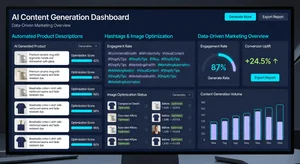
Image Production Without a Photography Budget
Visual content is the fuel of e-commerce marketing, and producing it at the volume social channels require is one of the hardest constraints small-to-mid teams face. Studio shoots are expensive. Stock photography is generic. And the gap between the visuals you can create in-house versus what a fully-staffed design team produces is visible.
AI-powered image tools have meaningfully narrowed that gap. Background removal, which once required a skilled retoucher, now happens automatically in seconds. Portrait enhancement, color correction, background blur, format conversion: all of these can now be done through browser-based tools that require no design background.
For marketers, this means that product photo processing, which might have previously required briefing an agency or waiting for a designer's availability, can happen in-house on demand. When a new product launches and you need 20 cleaned-up product shots ready for listings, social, and email by end of week, you're not blocked waiting for design resources.
The AI writing assistant handles the textual equivalent: product descriptions, social captions, email subject line variations. A marketer who understands the product and the customer can use these tools to draft copy at three or four times their normal output speed, then apply judgment to refine what the AI generates.
Content Planning as a System, Not a Sprint
One of the patterns that separates high-performing e-commerce marketing teams from stressed-out ones is having a content system rather than a content sprint. The sprint approach is exhausting: you're always rushing to fill the next hole in the calendar. The system approach means content exists as inventory, created ahead of need.
Cliptics' content planner supports this by giving marketers a structured way to map campaigns, content types, and publishing schedules. When your content is planned a month ahead and you have AI tools helping generate the drafts, the weekly publishing workload shrinks from a production scramble to mostly execution.
The planning investment upfront pays back in reduced stress and more consistent output quality. Rushed content is almost always weaker content.
Hashtag Strategy Without Manual Research
Social distribution is only as effective as your visibility strategy, and hashtag selection is one of those tasks that sounds simple but eats time when you're doing it properly. Researching trending hashtags, checking engagement levels, finding the right mix of broad and niche tags for each post: manual hashtag research for a week of social content can take an hour or two.
Cliptics' hashtag generator does this automatically, generating platform-optimized hashtag sets for any product or content type. For e-commerce marketers managing multiple product categories and multiple channels, the time saved adds up fast.
The Case for Tool Consolidation
One underappreciated source of marketing inefficiency is tool sprawl. When your team uses six different tools for image editing, content writing, scheduling, and research, the context-switching cost is real. Time lost navigating between tools, re-learning interfaces, managing separate logins adds up to hours per week.
The value of platforms that consolidate multiple AI marketing tools isn't just the individual capabilities. It's the reduction in friction across the workflow. When image editing, content generation, and planning tools all live in the same place, work just moves faster.

What AI Tools Don't Replace
The reason AI tools are additive rather than substitutive for skilled marketers is that the judgment layer still requires people. Knowing which content angle will resonate with your specific audience. Understanding what your brand voice sounds like and correcting when the AI drifts from it. Reading market signals and adjusting strategy. Building genuine relationships with customers.
AI tools are most valuable when they eliminate the mechanical work so marketers can spend more time on the strategic and creative work that actually requires human experience. The marketers who will feel displaced by these tools are the ones whose primary value was executing repetitive tasks. The ones who use AI tools to do more of the thinking-level work will become significantly more effective.
The shift is already happening. The question isn't whether to adopt these tools, but how thoughtfully to integrate them into existing workflows.