How to Start a YouTube Channel in 2026: A Brutally Honest | Cliptics
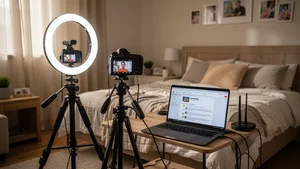
I started my first YouTube channel with a $40 microphone, my phone propped against a stack of books, and the kind of blind confidence that only comes from having absolutely no idea what you're getting into.
That channel got 14 subscribers in three months. Twelve of them were family members. One was my landlord. The last one was a bot from Indonesia.
So yeah. I'm not going to feed you some inspirational story about how I quit my job and hit 100K subscribers in six months. That's not how this works for most people. What I can do is tell you exactly what starting a YouTube channel in 2026 actually looks like, what nobody warned me about, and what I wish someone had told me before I wasted months doing things the wrong way.
The Part Where Everyone Lies to You
Every "how to start YouTube" guide opens the same way. Find your niche. Be passionate. Be consistent. Upload three times a week.
And technically, that advice isn't wrong. It's just incomplete in a way that borders on dishonest.
Finding your niche sounds simple until you're sitting in front of your laptop at midnight, convinced you have nothing interesting to say. Passion is great until your fourth video gets 23 views and you start questioning whether passion is enough. Consistency matters until you realize that uploading three videos a week while working a full-time job means you don't sleep anymore.
Here's what actually matters in 2026. YouTube is more competitive than it's ever been. There are over 114 million active channels right now. The algorithm has gotten smarter, more ruthless, and more unpredictable. Shorts have completely changed the discovery game. And the bar for production quality keeps climbing because viewers have seen everything.
None of that means you shouldn't start. It just means you should start with realistic expectations instead of fantasy timelines.
What You Actually Need (And What You Don't)
Let me save you some money. You don't need a $2,000 camera. You don't need a professional studio. You don't need expensive editing software on day one.
Here's what you actually need to start:
Your phone. Seriously. Modern phones shoot in 4K. The camera in your pocket is better than what professional YouTubers used five years ago. Stop using "I don't have good equipment" as an excuse. It's the most popular excuse in the world and it's not valid anymore.
A decent microphone. This is the one thing I'd actually spend money on. Bad audio kills videos faster than bad video does. A $50 USB microphone will serve you well. Viewers will forgive shaky footage. They won't forgive audio that sounds like you're recording inside a washing machine.
Natural light or one cheap ring light. Lighting is the single biggest upgrade you can make to your video quality for the least money. Sit facing a window during the day. Done. Free.
Free editing software. DaVinci Resolve is professional-grade and completely free. CapCut handles most editing needs and has a gentler learning curve. You don't need Premiere Pro. Not yet. Maybe not ever.
OBS Studio if you're doing screen recordings or tutorials. Free, open source, and powerful enough that plenty of full-time creators still use it.
That's it. That's your starter kit. Everything else is procrastination disguised as preparation.
The First 30 Days Nobody Talks About
Your first month is going to be rough. I need you to understand that upfront.
Your first video will be terrible. Not "could be better" terrible. Actually terrible. You'll watch it back and cringe. Your voice will sound weird to you. Your editing will be clunky. You'll say "um" 47 times in a 10-minute video. You'll spend eight hours editing something that gets 11 views.
This is normal. This is what's supposed to happen.
The creators you admire? Go watch their first videos. Most of them are embarrassingly bad. The difference between them and the people who quit is simple: they kept going anyway.
In your first month, focus on exactly two things. Getting comfortable on camera and learning your editing software. That's it. Don't worry about thumbnails. Don't worry about SEO. Don't worry about analytics. Just make things and finish them.
Finishing is the skill nobody talks about. Starting projects is easy. Finishing them when they don't look like what you imagined is where most people break.
The Algorithm Isn't Your Enemy (But It's Not Your Friend Either)
Here's what I've learned about how YouTube actually works in 2026.
The algorithm doesn't promote channels. It promotes individual videos. This means every single upload is a fresh chance, which is both liberating and terrifying. Your tenth video could be the one that takes off, even if your first nine flopped.
Click-through rate and average view duration are the two metrics that matter most. If people click on your thumbnail and then actually watch your video, YouTube shows it to more people. If they don't click, or they click and leave after 30 seconds, your video dies quietly.
This means your thumbnail and title are not afterthoughts. They're arguably the most important part of your video. You can make the best content in the world, but if nobody clicks, nobody sees it.
YouTube Shorts are the fastest way to get discovered in 2026. The Shorts algorithm is more generous with new creators than the long-form algorithm. It's not uncommon for a new channel to get 10,000 views on a Short while struggling to break 100 on long-form videos. Use Shorts to build an audience, then funnel them toward your longer content.
And please, for the love of everything, stop checking your analytics every hour. Check them once a week. The daily numbers will make you crazy. The weekly trends will actually teach you something.
The Money Question (Since I Know You're Thinking It)
Let me be direct. You are not going to make money from YouTube for a long time.
The YouTube Partner Program requires 1,000 subscribers and 4,000 watch hours in the past 12 months for long-form monetization, or 1,000 subscribers and 10 million Shorts views in 90 days. Most new creators take 12 to 18 months to hit those thresholds. Some take longer.
And even when you do get monetized, the money is modest at first. CPM rates vary wildly by niche, but a channel getting 50,000 views a month might earn somewhere between $100 and $500, depending on the topic and audience demographics. That's not life-changing money.
The real money on YouTube comes from sponsorships, affiliate marketing, and selling your own products or services. But those opportunities don't appear until you've built an audience. Which takes time. Which requires patience.
Start YouTube because you genuinely want to create content. If you start it purely for money, you will quit before the money arrives.
The Tools That Actually Help
You don't need a hundred tools. You need a handful of good ones.
TubeBuddy or VidIQ for keyword research and SEO. Pick one. Both have free tiers. They'll show you what people are actually searching for so you're not guessing.
Canva for thumbnails if you don't want to learn Photoshop. The free tier handles everything a beginner needs. If you want more options, tools like Cliptics offer free thumbnail generation and even text-to-speech for voiceovers, which can save you hours when you're experimenting with different content styles.
A simple content calendar. Google Sheets works. Notion works. A notebook works. The tool doesn't matter. Having a plan matters.
That's genuinely all you need. Every other tool is optimization for problems you don't have yet.
What I'd Do Differently If I Started Over Today
If I were starting a YouTube channel from scratch in 2026, here's exactly what I'd do.
I'd spend two weeks researching before uploading anything. Watch 50 videos in my target niche. Study their thumbnails. Read their comments. Understand what the audience actually wants, not what I think they want.
I'd make my first 10 videos in 30 days. Quantity over quality at the start. Every video teaches you something. The faster you learn, the faster you improve.
I'd publish one Short for every long-form video. Two content formats, one recording session. Efficient and effective for discovery.
I'd pick a schedule I can actually maintain for a year. If that's once a week, great. If that's twice a month, fine. Burnout kills more channels than bad content does.
I'd ignore subscriber count for the first six months and focus entirely on getting better at making videos. Subscribers are a lagging indicator. Skill improvement is a leading indicator.
And I'd find one or two other creators at my level and support each other. Not for cross-promotion. Just for accountability. Having someone who understands what you're going through makes the hard months survivable.
The Honest Truth About Starting
Starting a YouTube channel in 2026 is simultaneously easier and harder than it's ever been. Easier because the tools are better, cheaper, and more accessible. Harder because the competition is fierce and audience expectations are high.
But here's what I keep coming back to. The people who succeed on YouTube aren't the most talented. They're not the best looking or the best equipped. They're the ones who kept uploading when it felt pointless. Who kept learning when progress was invisible. Who treated every bad video as tuition, not failure.
You're going to make bad videos. You're going to have months where growth flatlines. You're going to question whether any of this is worth your time.
And if you keep going anyway, you'll eventually look back and realize that starting was the hardest part. Everything after that was just practice.
So start. Start messy. Start scared. Start with your phone and a cheap microphone and terrible lighting.
Just start.