
"Humanoid Robots 2026: They're Now Working in Factories | Cliptics"
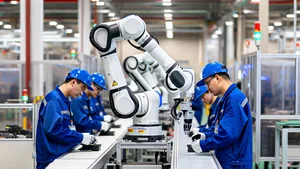
Something happened this year that I genuinely did not expect to see so soon. Humanoid robots are working in factories. Not in concept videos. Not in controlled demos with carefully scripted scenarios. They are on actual production lines, running ten hour shifts, and helping build cars that real people drive.
I have been following robotics for years, and there was always this unspoken understanding that humanoid factory workers were "five to ten years away." Well, it is 2026, and that timeline just collapsed. The convergence of better AI models, cheaper hardware, and massive corporate investment turned what felt like distant science fiction into something you can visit on a factory tour.
Let me walk you through what is actually happening right now, because the reality is both more impressive and more nuanced than the headlines suggest.
Figure AI and BMW: 30,000 Cars and Counting
The most concrete proof that humanoid robots belong in factories comes from Figure AI's deployment at BMW's plant in Spartanburg, South Carolina. Their Figure 02 robot completed an eleven month deployment on an active assembly line, and the numbers are hard to argue with.
During that period, Figure 02 contributed to the production of over 30,000 BMW X3 vehicles. It ran ten hour shifts, Monday through Friday. It handled more than 90,000 sheet metal components and took roughly 1.2 million steps across approximately 1,250 operating hours. The robot's job was loading three metal parts onto welding fixtures with a tolerance of just 5 millimeters, and it had to do it in under 84 seconds per cycle with greater than 99% accuracy.
That is not a toy. That is a machine performing precise, repetitive industrial work at a level that meets production standards.
BMW was apparently impressed enough that they are expanding to Europe. Their Leipzig plant in Germany began testing in late 2025, with a full pilot phase scheduled for summer 2026. Interestingly, the Leipzig deployment uses AEON robots from Hexagon Robotics rather than Figure AI, focusing on high voltage battery assembly and component manufacturing. Different robots for different tasks, which tells you something about how this market is developing.
Boston Dynamics Atlas Goes Commercial
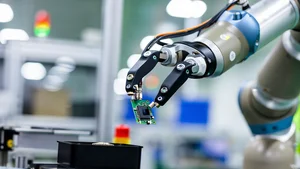
Boston Dynamics made the move everyone expected but nobody was sure would actually happen. Their electric Atlas robot is no longer just a research platform. It is a commercial product, and every single unit scheduled for 2026 deployment is already committed.
The robot stands 5 feet 9 inches tall, weighs about 200 pounds, and is designed to match human scale while exceeding human endurance. Unlike traditional factory robots that stay bolted to one spot performing a single motion over and over, Atlas can walk, lift, turn, and adapt to different tasks across a facility.
The first deployments are heading to Hyundai's Robotics Metaplant Application Center and to Google DeepMind. Hyundai, which owns Boston Dynamics, has openly discussed plans to deploy thousands of humanoid robots across its factories in the coming years. The Metaplant in Georgia is the proving ground.
What makes Atlas different from earlier humanoid robots is the AI running on its NVIDIA processors. The robot does not just follow pre programmed sequences. It uses perception and decision making to handle tasks that vary slightly from cycle to cycle, which is exactly the kind of adaptability that factories need but have never been able to get from traditional automation.
NVIDIA's Physical AI Push
If there is one company that ties all of this together, it is NVIDIA. At GTC 2026 in March, Jensen Huang made a statement that landed like a declaration: "Physical AI has arrived. Every industrial company will become a robotics company."
NVIDIA announced several things that matter for this space. Cosmos 3 is now the first world foundation model that unifies synthetic world generation, vision reasoning, and action simulation. In practical terms, it lets robot developers train and test their machines in virtual environments before deploying them in real factories, dramatically cutting the cost of development.
Then there is GR00T N1.7, now available with commercial licensing, bringing generalized robot skills including advanced dexterous control to production ready deployments. And Huang previewed GR00T N2, a next generation model that helps robots succeed at new tasks in new environments more than twice as often as leading alternatives.
The partner list tells the story of where this is heading. ABB Robotics, FANUC, Figure, Hexagon Robotics, KUKA, Universal Robots, and YASKAWA are all building on NVIDIA technology. These are not startups experimenting in garages. These are the companies that already run the world's factories.
Tesla's Optimus: Scale Nobody Else Is Attempting
Tesla is approaching this differently from everyone else, and their scale ambitions are almost absurd. In January 2026, they announced that they are ending production of the Model S and Model X at the Fremont factory and repurposing those lines to build Optimus humanoid robots instead.
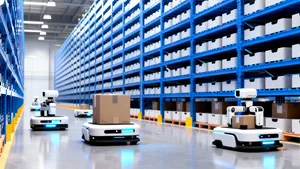
They have already deployed over 1,000 Optimus Gen 3 robots across their global manufacturing facilities, primarily at Gigafactory Texas and Fremont. These robots handle sorting parts, moving materials, and assisting on assembly lines. Tesla broke ground on a massive Optimus manufacturing facility at Gigafactory Texas with the ambition of eventually producing 10 million units per year.
Whether Tesla can actually hit those numbers is an open question. But the strategy is clear: build the robots, deploy them internally first, prove they work, then sell them to everyone else. It is the same playbook they used with batteries and solar, scaled up to humanoid robotics.
What This Actually Means Going Forward
Here is the thing that keeps striking me about all of this. We are not talking about one company running an experiment. We are talking about BMW, Hyundai, Tesla, and Google all deploying humanoid robots simultaneously, backed by NVIDIA's AI infrastructure and a growing ecosystem of robotics companies.
The robots are not replacing human workers overnight. Figure 02 at BMW handled one specific task on one part of the line. Atlas is going to specific application centers first. Optimus is starting with internal Tesla operations. This is careful, methodical expansion, not sudden wholesale replacement.
But the trajectory is unmistakable. The technology works. The economics are being proven. The AI models are getting better at a pace that should make anyone pay attention.
2026 is not the year humanoid robots took over factories. It is the year they proved they belong there. And that distinction matters, because what comes next is going to move a lot faster than what came before.