
Jewelry Try-On Tech Cuts Return Rates by 47% | Cliptics

Returns are killing your jewelry business. Let's fix that.
I'm not going to sugarcoat this. When customers buy jewelry online, they're taking a massive leap of faith. Does that ring actually fit? Will those earrings overwhelm their face? Is that necklace length right for their neckline?
When they guess wrong, the piece comes back. You eat the shipping. The item sits in returns processing. Your margin disappears.
Virtual try-on technology solves this problem directly. Customers see jewelry on themselves before they buy. Not on a model. On their actual face, neck, wrist, or finger. That changes buying behavior completely.
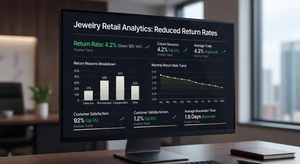
The data backs this up. Jewelry retailers using virtual try-on report return rate drops between 40% and 55%. The median sits around 47%. That's not marginal improvement. That's a different business model.
Why Jewelry Returns Happen
Most jewelry returns boil down to three things.
Size is wrong. A ring doesn't fit. A bracelet is too loose or too tight. Customers eyeball it from product photos and measurements, then hope for the best. Sometimes they're right. Often they're not.
Style doesn't match. That statement necklace looked amazing on the model but feels too bold in real life. Those chandelier earrings seemed perfect until they actually tried them on. The disconnect between product photo and reality kills sales.
Color or finish doesn't work. Rose gold looked warmer in the listing. The gemstone color isn't quite what they expected. Lighting in product photos can make this worse.
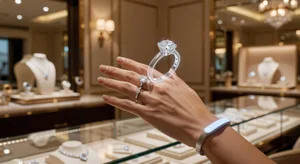
Virtual try-on eliminates most of these issues before checkout ever happens. When someone can see that necklace on their actual neck, in their actual lighting, wearing their actual outfit, the guesswork disappears.
How the Technology Actually Works
Your customers use their phone camera or webcam. The software maps their face, neck, wrist, or hand in real time. Then it overlays your jewelry onto their image, accounting for angles, lighting, and movement.
Good systems track motion. If someone turns their head, the earrings move naturally. If they tilt their wrist, the bracelet shifts realistically. That level of accuracy builds confidence that what they're seeing is what they'll get.
For rings, the tech measures finger size using the phone camera and a reference object like a credit card. Not perfect, but way better than customers guessing based on a size chart.
Setup takes anywhere from a few days to a couple weeks depending on your product catalog and platform. Most virtual try-on providers handle the heavy lifting. You provide product images and specs. They build the 3D models and integrate with your site.
The Math That Matters
Let's talk numbers.
Say you sell $50,000 in jewelry monthly. Your return rate is 35%. That's $17,500 coming back. At an average processing cost of $12 per return plus lost margin, you're burning roughly $6,000 to $8,000 monthly just handling returns.
Now cut that return rate to 18% with virtual try-on. Your monthly returns drop to $9,000. Processing costs fall to around $3,200. You just saved $4,000 to $5,000 per month.
Most virtual try-on services charge between $200 and $800 monthly depending on features and volume. Even at the high end, you're net positive by month two.
That's before you factor in conversion lift. Retailers report 15% to 35% higher conversion rates on products with virtual try-on enabled. When customers can see themselves wearing the piece, they buy more often.
One boutique jeweler told me their average order value increased 22% after adding try-on. Customers felt more confident buying multiple pieces or going for the more expensive option when they could see it on themselves first.
Where It Works Best
Not all jewelry categories get the same benefit.
Rings see massive impact. Sizing is the number one return reason for rings, and virtual try-on addresses that directly. One ring retailer cut their returns from 48% to 19% in three months.
Necklaces and pendants benefit significantly. Length and style uncertainty drive returns here, and seeing the piece on your actual neck solves both problems.
Earrings work well, especially statement pieces and chandeliers. Customers worry about size and proportion. Virtual try-on answers those questions immediately.
Bracelets and watches show moderate improvement. Still worth setting up, but the return rate drop tends to be smaller than rings or earrings.
Fine jewelry and engagement rings get the biggest ROI. When average order values run $1,000 to $10,000, even a small reduction in returns means serious money.
Customer Behavior Changes
Something interesting happens when you add virtual try-on to your product pages.
Time on page increases. People spend longer looking at products when they can interact with them. That extra engagement correlates with higher purchase intent.
Cart abandonment drops. One jewelry site saw cart abandonment fall from 71% to 54% after adding try-on. When customers feel confident about fit and style, they stop hesitating at checkout.
Support tickets about sizing decrease dramatically. Instead of emailing to ask if a certain necklace length will work for them, customers just try it on virtually and know.
Repeat purchase rates climb. Customers who successfully buy using virtual try-on come back more often. They trust the technology and they trust that what they see is accurate.
Setup Reality
Getting this up and running isn't complicated, but you need to think through a few things.
Your product photography matters more than before. The virtual try-on tech relies on accurate product images to build 3D models. If your photos are inconsistent or low quality, the virtual experience suffers.
Mobile optimization is critical. Most customers will use this feature on their phones. If the experience is clunky on mobile, adoption tanks and you won't see the benefits.
Customer education helps initially. A small prompt or tooltip explaining how to use virtual try-on increases adoption. Don't assume people will figure it out on their own.
Integration with your existing platform varies by provider. Shopify, WooCommerce, and other major platforms usually have straightforward plugins. Custom sites might need developer work.
What You Should Actually Measure
Don't just set up this and hope it works. Track specific metrics.
Return rate by product category before and after setup. This shows you where virtual try-on delivers the most value.
Conversion rate on pages with try-on versus pages without. If the lift is meaningful, prioritize rolling it out to more products.
Customer support tickets related to fit and sizing. These should drop noticeably within the first month.
Time on product pages and engagement with the try-on feature. If people aren't using it, something's wrong with the setup or positioning.
Give it twelve weeks of data before making big decisions. The first few weeks can be noisy as customers discover the feature and your team learns what works.
The Competitive Angle
Here's what a lot of jewelry retailers miss.
Virtual try-on isn't just about reducing returns. It's a differentiator when every other online jeweler is selling the same products with the same product photos.
When someone can try on that ring or necklace on their own hand or neck, your site becomes stickier than competitors who only offer static photos. That's customer acquisition and retention wrapped into one feature.
I've talked to jewelers who started winning customers from bigger retailers specifically because their try-on experience felt more personal and gave buyers more confidence. That's a powerful position when you're competing against sites with deeper pockets for advertising.
For sunglasses and fashion jewelry, this advantage compounds. These categories are all about how the piece looks on you. Virtual try-on turns that from a weakness of online shopping into a strength.
Bottom Line
If you sell jewelry online and your return rate is above 20%, you need to look at this seriously.
The ROI shows up fast. Setup isn't complex. And the competitive advantage matters more as this technology becomes table stakes.
Start with your highest-return product categories. Measure the impact. Then expand from there. The data will make the decision obvious.