
Multi-Voice AI Text-to-Speech: Create an Entire Audiobook | Cliptics

The economics of traditional audiobook production have excluded most independent authors. A professional narrator charges $200-400 per finished hour. A 70,000-word novel produces roughly 8-9 hours of audio. Before you add studio time or mastering, you're looking at $1,600-3,600 minimum for one book.
Self-recording is the obvious alternative, but it comes with its own barrier: you need a quiet space, a decent microphone, audio editing software, and the willingness to re-record until the quality is consistent across hours of content. Most people who've tried it know how hard "consistent quality across 9 hours" is in practice.
Multi-voice AI text-to-speech changes this equation completely.
What Multi-Voice TTS Actually Enables
Standard text-to-speech converts text to a single voice. Multi-voice TTS allows you to assign different voices to different speakers within the same content, which makes the difference between tolerable and genuinely good for audiobook production.
A narrator voice handles all description and scene-setting. Character voices are assigned to dialogue. In a well-produced audiobook, the listener can track who's speaking across complex dialogue exchanges without the author's "said John" attribution becoming obtrusive. Multi-voice TTS replicates this in audio production without requiring a cast of narrators.
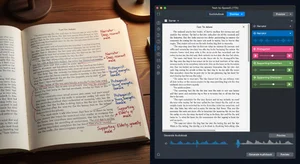
Cliptics AI Multi-Voice Text-to-Speech handles this through voice assignment at the text level. You mark up your manuscript to indicate voice assignments, the system renders each passage in the assigned voice, and the outputs splice together smoothly.
Preparing Your Manuscript for Multi-Voice Production
The production quality of your audiobook depends significantly on how you prepare the source text. Preparation that takes an extra few hours on the front end prevents significant rework on the back end.
Start by reading your manuscript aloud. Note any passages that work as written prose but feel odd when spoken. Common issues: sentences that are too long for natural breath rhythm, repetitive sentence structures that become monotonous as audio, dialogue tags that work on the page but feel redundant when a distinct character voice makes the attribution unnecessary.
Simplify long sentences. Add natural pause points. In audiobook format, a period is where the listener takes a breath, so the natural rhythm of your prose matters in a way it doesn't in print.
For dialogue-heavy books, mark up every line of dialogue with the speaker's name before you start voice assignment. This becomes the annotation layer the TTS workflow uses.
Voice Selection and Character Design
The voice palette for a novel is a creative decision that works best with a framework. Most successful multi-voice audiobooks use 3-6 distinct voices total: one primary narrator voice, and one to four character voices for the most important or frequently speaking characters.
Minor characters and walk-ons don't need dedicated voices. Using the narrator voice for a character who appears in one scene prevents voice proliferation that becomes confusing to track.
For each major character, think about vocal qualities that fit the character's attributes and role: age, gender, cultural background, personality type. Test voice options against several lines of the character's most characteristic dialogue, not their most neutral lines.
Consistency matters more than perfect character match. A voice that's 90% right and used consistently throughout is better than switching voices mid-book because you found something that felt better in later chapters. Listeners build auditory character memories, and inconsistency breaks them.
The Production Workflow in Cliptics
Once you have your marked-up manuscript and voice assignments decided, the actual production workflow in Cliptics text-to-speech proceeds chapter by chapter.
Process one chapter at a time rather than the entire manuscript at once. This lets you evaluate and adjust voice settings before committing to 200 pages of output. Chapter-level processing also makes revision manageable: if you change your mind about a character's voice, you revise that chapter rather than the entire book.
For each chapter, run the full text through the tool with voice assignments active. Listen to the output at 1.5x speed during your first review pass to catch technical issues (mispronunciations, odd pacing at line breaks) without spending full review time. Flag timestamps for any issues.
Common issues to listen for: unusual name pronunciations (the tool usually handles common names but may stumble on invented or unusual ones), chapter transitions that feel abrupt, and passages where the tone of the voice doesn't match the emotional content.
Handling Difficult Text Elements
Numbers, abbreviations, and special formatting require specific handling in TTS production.
Numbers: Write them out phonetically in your TTS version. "Chapter 12" becomes "Chapter Twelve." Dates, statistics, and measurements should all be spelled out. "She was born in 1987" becomes "She was born in nineteen eighty-seven."
Abbreviations: Expand all abbreviations. "Dr." becomes "Doctor," "St." becomes "Saint" or "Street" depending on context, "approx." becomes "approximately."
Dialogue punctuation: Em dashes in dialogue (indicating interrupted speech) are handled inconsistently by TTS systems. If your manuscript uses them for interruption, revise to a period or comma for the TTS version to ensure clean pacing.
The Final Assembly Process
Individual chapter outputs need to be assembled into a complete audiobook. Basic audio editing software (Audacity is free and sufficient) handles this assembly.
Import all chapter files in order. Listen to the transitions between chapters to ensure consistent pacing at chapter breaks. Most audiobooks use 2-3 seconds of silence between chapters; some add a brief audio sting or ambient sound.
Export at the correct specifications for your distribution platform. Audible/ACX requires specific technical specifications (192kbps MP3, consistent volume levels, specific room tone standards). Findaway Voices, Draft2Digital Audio, and direct distribution to other platforms each have their own requirements. Review these before finalizing your export settings.
Distribution and Commercial Reality
Audiobook distribution in 2026 has several strong options for independent authors: Audible/ACX for the largest single market, Findaway Voices for broad distribution across smaller platforms, and direct sales through your own site using Payhip or Gumroad.
The key commercial reality: multi-voice AI audiobooks are now accepted on all major distribution platforms. The quality bar has risen to where AI-produced audio is commercially viable. The residual stigma around self-produced audio has been largely replaced by listener acceptance of quality as the primary standard regardless of production method.
For an author who would otherwise not produce an audiobook at all, a quality AI-produced audiobook represents pure incremental revenue. It reaches listeners who prefer audio, extends the life of the written work, and creates a format that can be sold or given away as a marketing tool.
The upfront preparation work is real, but the production cost barrier that excluded most independent authors from the audiobook market has effectively been removed.