
The Hidden SEO Power of Multilingual Audio Content: Why | Cliptics
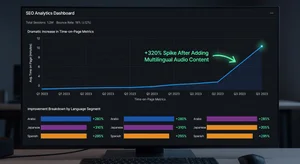
When we added an Arabic audio version of our highest-traffic blog post, average time-on-page for Arabic-language visitors went from 47 seconds to 4 minutes and 12 seconds. That's not a rounding error. That's an 436% increase in the engagement signal that Google weights most heavily in ranking decisions.
The mechanism is simple: readers skim content. Listeners consume it. When you give a non-native speaker the option to listen in their language while following along in yours, they engage at reader depth with listener time investment. For SEO, that combination is remarkably powerful.
Why Time-on-Page Matters More Than Links in 2026
Google's ranking signals have evolved. The era when backlink count was the dominant ranking factor gave way to a more nuanced model that weights user behavior signals heavily, including dwell time (how long someone stays on your page), pogo-sticking rate (whether they bounce back to search results quickly), and engagement pattern signals from Chrome.
Time-on-page isn't a direct ranking factor in isolation. But it's highly correlated with the signals Google does measure. A visitor who spends 4 minutes on your page is almost certainly engaging with the content. A visitor who spends 25 seconds may have landed and immediately concluded you didn't have what they needed.
For pages competing in crowded SERPs, marginal improvements in engagement signals create meaningful ranking advantages over time. A page with consistently better user engagement than its competitors accumulates a long-term ranking advantage that individual link building can't easily replicate.
The Mechanism: Why Multilingual Audio Works So Well
Non-native readers of your content are expending cognitive energy on language processing that native speakers don't expend. This creates a fatigue factor: dense, complex content in a second language is harder to stay with than the same content in your native language.
Listening to a native-language audio version while reading (or instead of reading) reduces this cognitive load dramatically. The content becomes accessible at a different level of engagement because the comprehension barrier is partially removed.
The users who benefit most: people who have working professional literacy in your content language (English, typically) but whose primary language is Arabic, Japanese, Spanish, Portuguese, or another major language. This is an enormous global audience. Professional-level English literacy is widespread in markets where the primary language isn't English.
Adding audio in their native language isn't condescending. It's recognizing that consumption preferences differ and removing a barrier that exists for a large segment of your audience.
Which Languages Deliver the Most SEO Impact
The practical ranking impact varies by language depending on two factors: the size of the language's search market and the amount of quality content already available in that language.
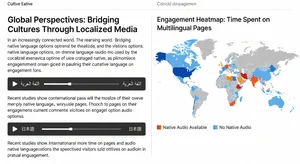
Japanese and Arabic represent particularly strong opportunities in 2026. Both have large, high-value search markets (Japan and the Middle East/North Africa region are substantial digital advertising markets) and both are underserved by quality multilingual content from English-language publishers.
The content gap creates the SEO opportunity: Google will rank your English-language page with Japanese or Arabic audio components in both English and the respective language search results if the structured setup is correct. You're not just improving existing rankings. You're opening new search surfaces.
Spanish is well-covered relative to Arabic and Japanese, but the Latin American market represents geographic pockets where quality audio content creates advantages for specific industries.
Setup: Adding TTS Audio to Existing Content
Cliptics Text-to-Speech and Cliptics AI Multi-Voice Text-to-Speech handle the audio generation component. The workflow for adding multilingual audio to existing content:
First, prepare the text for translation and audio generation. This isn't a direct machine-translation step: the text needs to be reviewed for culturally specific references that may not translate cleanly, and simplified for any idioms that are clear in English but awkward in translation.
Use a professional translation service for the text (machine translation is improving but not yet at quality parity for content that represents your brand). The translation cost is typically $0.08-0.12 per word for professional translation of blog content, which means a 1,500-word article costs $120-180 for professional translation into one language.
Generate the audio from the translated text using Cliptics TTS, selecting the appropriate language voice. Review the output for pronunciation issues with names, technical terms, and any specialized vocabulary.
Add the audio player to your page with an HTML5 audio element. Include the language designation in the markup so Google can correctly attribute the language content.
Structured Setup for Maximum SEO Benefit
The technical setup matters for capturing the full SEO benefit. Simply adding an audio player isn't sufficient. The content needs to be structured so Google's crawlers can identify the language and associate it correctly with the page.
Add hreflang annotations if you have separate language versions. For audio-only additions on the same page, the audio element itself signals the language content to crawlers.
Include a text transcript of the audio in the page markup (can be hidden visually but present in the DOM). The transcript gives Google crawlable content in the target language and may appear in featured snippets for searches in that language.
Add schema markup for audio content: AudioObject schema helps Google understand what the audio element contains and how to index it.
The Business Case Beyond SEO
The SEO argument for multilingual audio is strong, but it's not the only argument.
Accessibility: audio content serves users with visual impairments, reading difficulties, and attention differences. This isn't a niche audience consideration. In the Arabic-speaking world specifically, audio content consumption patterns differ significantly from Western markets, with higher preference for audio over text-based content consumption.
Brand differentiation: producing quality multilingual audio content at scale is still unusual enough that it creates a notable differentiator in many content categories. Being the publication that offers Japanese audio of your English content creates a distinctive market position.
Content longevity: audio content extends the life of written pieces. Listeners who consumed the audio version of a piece will share it in audio-consumption contexts (podcasting communities, messaging groups, social media audio features) that your text content wouldn't reach.
The Prioritization Decision
Not every piece of content justifies the investment in professional translation and audio production. The highest-priority candidates:
Your top 10-20 organic traffic pages, where ranking improvements have the most impact. Long-form resource pages and guides, where extended engagement is most valuable. Content targeting industries with significant international professional audiences (technology, finance, manufacturing, pharmaceuticals).
The framework: estimate the traffic value of a page (its organic monthly sessions multiplied by the click value for those keywords). If a 20% improvement in time-on-page metrics could generate a measurable ranking improvement for that traffic value, the translation and audio investment has a clear ROI case.
For a page driving 5,000 monthly organic visits at a keyword average CPC of $4, the implied traffic value is $20,000 per month. A $150 translation and 30 minutes of audio production for one language version is a straightforward investment at that scale.
The first language addition will teach you most of what you need to know to scale the approach. Start with your highest-traffic English-language content and one target language that matches your audience's geography. Measure the time-on-page change over 60 days. The data will tell you whether to expand.

The mechanism is real, the setup is accessible, and the competitive advantage is still early enough that first movers will benefit from it before it becomes standard practice. Audio is where your international audience wants to engage. Give them that option and the engagement metrics will reflect it in your rankings.