Neuromorphic Computing for Mobile Apps: Brain-Inspired | Cliptics
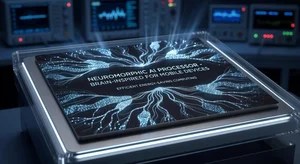
Every time you use an AI feature on your smartphone, your phone makes a decision about where to run that computation. Some AI tasks get sent to cloud servers, processed there, and the result is sent back. Others run directly on the device using dedicated AI chips. The choice matters enormously: for battery life, for privacy, for speed, and for what is even possible at all.
Neuromorphic computing represents a fundamentally different approach to the third option in this decision: computation that works more like a brain than a calculator. The efficiency gains are not incremental. They are categorical.
What Neuromorphic Computing Actually Means
Traditional computing processes information in a precise, sequential way. Data moves between memory and processor in clearly defined steps. Instructions execute one at a time (or in manageable parallel batches). The architecture was designed for deterministic calculation, and it is extraordinarily good at that.
Brains work differently. Neurons fire asynchronously only when they have something to communicate. Most neurons are silent most of the time. Information is represented as patterns of activation across networks rather than discrete binary values. The system is massively parallel and massively sparse.
Neuromorphic chips apply these principles to silicon. Intel's Loihi 2 chip contains 1 million artificial neurons and 120 million synapses. IBM's NorthPole architecture processes information without ever accessing external memory, eliminating one of the largest sources of energy consumption in traditional computing.
The practical result: tasks that require traditional silicon to process continuously can be handled by neuromorphic chips that only activate the circuits relevant to the specific input at that moment. For sparse signals like audio monitoring, visual scanning, and many real-world sensor inputs, this produces 10 to 100 times better energy efficiency.
Why This Matters for Mobile Apps
Smartphone AI features are currently limited by two constraints: battery life and heat.
Running a language model on a phone consumes significant power. Running continuous visual analysis (always-on augmented reality features, real-time video enhancement, persistent object recognition) drains batteries in hours. Heat generation constrains how long these tasks can run before throttling kicks in and performance degrades.
Neuromorphic architecture addresses both constraints simultaneously. Processing the same AI task with a neuromorphic chip uses a fraction of the power, generates less heat, and can therefore run continuously rather than intermittently.
This enables categories of mobile app features that are currently not practical:
Continuous environmental awareness: An app that genuinely monitors your surroundings all the time to provide contextual information without draining your battery before lunch.
Always-on accessibility features: Real-time audio transcription, visual assistance for visually impaired users, and gesture recognition that runs continuously without impacting battery life.
Persistent personalization: AI that observes how you use your phone all day and continuously adjusts to your patterns, without the processing cost that makes this impractical on current hardware.
Edge AI without compromise: Complex AI tasks that currently must be sent to the cloud for processing can run locally, improving both response speed and privacy.
The Privacy Dimension
When AI processing moves fully to the device, an important privacy shift occurs. Cloud-based AI requires sending your data to external servers for processing. Your voice, your camera input, your behavioral patterns: all of it leaves your device.
On-device neuromorphic AI processes everything locally. Your inputs never need to leave your phone. This has significant implications for sensitive applications: health monitoring, financial analysis, personal communications, and anything involving biometric data.
Privacy regulations are pushing in this direction as well. The EU AI Act and various national data protection frameworks are creating increasing pressure on AI systems to minimize data transmission. Neuromorphic on-device processing becomes a compliance advantage as well as a privacy benefit.
Current Hardware Landscape
Several major chip manufacturers have moved neuromorphic computing from research to commercial products.
Intel's Loihi 2 (in research and early commercial deployment) demonstrated 60x greater speed and 15x greater energy efficiency than conventional CPUs on certain AI workloads in independent benchmarks.
IBM's NorthPole architecture, announced in 2023, processes neural network inference without accessing external DRAM memory, which IBM reports yields 22x better energy efficiency than comparable GPU-based systems.
Apple's Neural Engine, present in every iPhone since the A11 chip, incorporates neuromorphic-inspired design principles, which is part of why on-device AI features on iOS phones run so much more efficiently than their raw compute specifications would suggest.
The next generation of mobile chips from Apple, Qualcomm, Samsung, and MediaTek are all incorporating more neuromorphic-inspired elements. By 2027, true neuromorphic processing is expected to be a standard feature in flagship smartphones.
Implications for App Developers
If you develop mobile applications, neuromorphic computing changes the constraints you design around.
Current mobile AI development requires difficult tradeoffs: send data to the cloud (slower, privacy concerns, requires connectivity) or run simplified models on-device (faster, private, but limited capability). Neuromorphic hardware dissolves this tradeoff for many application categories.
Features worth reconsidering for development or enhancement in the neuromorphic era:
On-device language understanding: Conversational features that currently require API calls to OpenAI or Google could run locally with full capability.
Real-time camera intelligence: Always-on scene understanding, object recognition, and augmented reality that do not drain the battery.
Continuous biometric monitoring: Health apps that genuinely track physiological signals all day without impacting battery life.
Intelligent notification management: AI that understands your context and attention patterns to deliver notifications at the right moments.
Persistent personalization engines: Recommendation and adaptation systems that learn continuously from device usage without cloud dependency.
The Adoption Timeline
Neuromorphic computing is not a future technology. Commercial products exist and are performing as described in independent research benchmarks. The gap is between research and commercial deployment in consumer devices.
The realistic adoption curve for mobile apps: experimental neuromorphic features begin appearing in flagship devices from 2025 through 2026. Mainstream adoption in mid-range devices follows in 2027 and 2028. Developer frameworks and APIs mature to make neuromorphic features accessible to app developers without specialized hardware knowledge.
For developers who want to prepare: learn the principles of sparse representation and event-driven computation. Study the frameworks Apple, Google, and Qualcomm are developing for neuromorphic features. Design your AI features with the assumption that local processing capability will expand dramatically over the next three years.
The efficiency revolution in mobile AI is arriving not through incremental improvement of existing approaches, but through a fundamental rethinking of how computation works. That is the kind of change worth tracking closely.