
Niche vs Viral Hashtags: Which Actually Grows Your Account | Cliptics
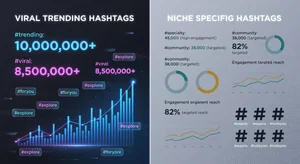
Let's cut through the noise. You've seen the advice everywhere: use viral hashtags to get massive reach. But if that actually worked, everyone would have millions of followers by now.
Spoiler alert: it doesn't work. At least not the way people think it does.
I've been testing hashtag strategies for the past two years across different account sizes. Small accounts under 1,000 followers. Medium accounts around 10,000. Bigger ones pushing 100,000. And what I found completely changed how I approach growth.
Viral hashtags barely move the needle. Niche hashtags are where actual growth happens. But not for the reasons most people tell you.
What Viral Hashtags Actually Do
Viral hashtags feel good to use. #love has 2.3 billion posts. #instagood has 1.7 billion. Using them makes you feel like you're in the game.
But here's what actually happens when you use a viral hashtag.
Your post gets added to a feed with millions of other posts. It shows up for maybe 30 seconds in the recent section before getting buried by the next hundred posts. A few people might see it. Most won't engage because they're just mindlessly scrolling a fire hose of random content.
The people who do see it aren't there for you. They're there for the tag. They don't care about your account. They're not going to follow you. They're just killing time scrolling #love at 2am.
I tested this. Posted the same image to a 5,000 follower account with two different hashtag sets. One used five viral tags over 500 million posts each. Other used five niche tags under 100,000 posts each.
Viral tags? Got 47 likes. Two of those were probably bots. Zero follows.
Niche tags? Got 23 likes. But also got 8 new followers and 3 saves. And those followers? They stuck around. They engaged with other posts. They actually cared about the content.
That's the difference. Viral gives you empty numbers. Niche gives you real people.
Why Niche Hashtags Work Better
Niche hashtags work because of intent.
Someone searching #sustainablewoodworking isn't browsing casually. They're specifically interested in sustainable woodworking. They want to see that content. They're looking for accounts to follow in that exact niche.
When your post shows up there, you're not competing with 10 million other posts. You're competing with a few thousand. Your content actually gets seen. It stays visible in the recent feed for hours, not seconds.
And the people seeing it are qualified. They're already interested in your topic. If your content's good, they'll follow. Simple as that.
Here's what changed everything for me: I stopped thinking about hashtags as reach tools and started thinking about them as targeting tools.
You're not trying to reach everyone. You're trying to reach the right people. The ones who'll actually care enough to follow and engage long term.
That's why tools like Instagram hashtag generators can be useful if they're good. Not for finding viral tags, but for discovering niche tags you didn't know existed. Tags that your exact target audience is actually using.
The Sweet Spot: Size Matters
Not all niche hashtags are equal though. Size matters.
Too small and nobody's searching it. Under 5,000 posts? Probably too niche unless you're in a super specialized field. You'll get lost because there's no active audience there.
Too big and you're back to the viral problem. Over 1 million posts and you're getting buried too fast to matter.
The sweet spot I've found is 50,000 to 500,000 posts. Big enough to have an active searching audience. Small enough that your content stays visible for a while.
Let's say you post about vegan meal prep. Don't use #vegan (94 million posts). Don't use #mealprep (17 million posts). Use #veganmealprep (760,000 posts). Even better, use #plantbasedmealprep (180,000 posts) or #veganbatchcooking (42,000 posts).
See how specific we got? That's the game now.
And layer them. Use hashtags at different size points in that range. One at 400,000. One at 150,000. One at 75,000. Two at 30,000. You're casting a targeted net at multiple levels.
Testing Your Way to What Works
Here's the part nobody wants to hear: you have to test for your specific account.
What works for a food blogger won't work for a fitness coach. What works for one fitness coach might not work for another fitness coach in a slightly different niche.
So test. And track.
I keep a simple spreadsheet. Post link, hashtags used, reach from hashtags, engagement rate, new followers. Every single post.
After about 20 posts you start seeing patterns. Certain tags consistently drive follows. Others drive likes but no follows. Some do basically nothing.
Double down on what works. Drop what doesn't. Keep testing new tags to see if they perform better.
It's tedious at first. But once you've got your proven tag sets, it's just maintenance. Test one new tag per post to see if it outperforms your current set.

The Biggest Mistake I See
People mix strategies. They'll use two viral tags for reach and three niche tags for targeting.
Don't do that. It dilutes everything.
Instagram's algorithm looks at how people engage with your post from each hashtag source. If people from a hashtag don't engage, Instagram assumes your content isn't relevant for that tag and stops showing it there.
When you use viral tags, you get low engagement from those sources. That hurts your overall hashtag performance across the board.
Stick with niche. All five tags should be intentional and relevant to your exact post content and target audience.
And yeah, this works cross platform too. Facebook hashtag strategies follow the same logic. Niche beats viral every time for actual follower growth.
What Growth Actually Looks Like
If you make this shift, here's what to expect.
Your reach numbers will probably drop. That's fine. Those weren't quality views anyway.
Your engagement rate should go up. Fewer people seeing your content, but more of them engaging.
Your follower growth will be slower but steadier. Instead of getting 50 followers one week and losing 45 the next, you'll get 8 to 12 consistent followers per week who actually stick around.
And your content will start performing better overall because you're building an engaged audience instead of empty follower counts.
It's less exciting in the moment. Nobody's making viral TikToks about steady 2% weekly growth. But it's sustainable. And it compounds over time.
That's the real game. Not viral moments. Consistent, targeted growth with people who actually care about your content.
The Bottom Line
Viral hashtags are a trap. They promise reach but deliver empty numbers.
Niche hashtags are the actual strategy. They promise relevance and deliver real audience growth.
Test your way to the right niche tags for your content. Track what works. Double down on those tags. Stop chasing viral.
That's it. That's the whole strategy. It's not sexy, but it works.