"Digital Privacy: Your Data Is Worth More | Cliptics"
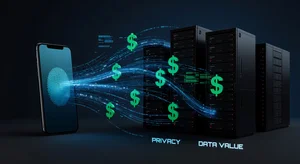
Your personal data is being sold right now. Not tomorrow. Not in some abstract future. Right now, as you read this sentence, data brokers are packaging your browsing habits, location history, purchase records, and social connections into profiles and selling them to the highest bidder. And here is the thing that should make you uncomfortable: the people buying that data know more about you than most of your friends do.
I have been tracking the data economy for years, and 2026 is the year where the gap between what people think their data is worth and what it actually sells for has become impossible to ignore. Let me break this down without the usual scare tactics. Just facts, numbers, and what you can actually do about it.
What Your Data Is Actually Worth
Most people think their personal data is worth maybe a few dollars. That is technically true if you are talking about a single record in a bulk sale. A data broker might sell your basic profile (name, email, rough demographics) for somewhere between $0.005 and $0.20. Sounds like nothing, right?
But that is the wholesale price. The retail value of your data, meaning what companies extract from it in targeted advertising, personalized pricing, and predictive analytics, is dramatically higher. Research from multiple privacy organizations now estimates that the average person's annual data value to the advertising space sits between $600 and $1,200 in the US. For high-value demographics (tech professionals, high earners, frequent shoppers), that number can exceed $3,000 annually.
Think about that. Companies are making thousands of dollars per year from your behavioral patterns, and you see exactly zero of it.
The Data Broker Machine Nobody Talks About
There are roughly 4,000 data broker companies operating globally in 2026. Most of them you have never heard of. They do not have consumer-facing products. They do not run ads. They exist entirely to collect, aggregate, cross-reference, and sell data about you.
Here is how the pipeline works. You visit a website. That site has tracking scripts from dozens of third parties. Those scripts record what you looked at, how long you stayed, what you clicked, and where you went next. That data gets sent to aggregators who match it with your identity across other platforms using device fingerprinting, email hashes, and probabilistic matching. Within hours, your browsing session from this morning has been correlated with your purchase history from last week and your location data from yesterday.
The result is a profile that includes your estimated income, health conditions, political leanings, relationship status, shopping preferences, travel habits, and hundreds of other data points. All inferred. All packaged. All for sale.
And the legal frameworks? They are still playing catch-up. The EU's GDPR has teeth, but enforcement is inconsistent. California's CCPA gives you the right to opt out, but the process is deliberately tedious. Most US states have no meaningful data privacy legislation at all.
Your Phone Is the Biggest Leak
Your smartphone is the single largest source of personal data leakage. It is not even close.
Location tracking alone paints an incredibly detailed picture of your life. Where you sleep (home address). Where you go every weekday morning (workplace). Which doctor you visit. Which stores you frequent. Whether you attend religious services. How often you visit a particular person's home.
Most people have between 40 and 80 apps installed on their phones. A significant percentage of those apps request and receive permissions they do not need. A flashlight app does not need access to your contacts. A weather app does not need your microphone. But people tap "Allow" because the alternative is not getting to use the app, and because the permission dialogs are designed to be dismissed, not read.
Bluetooth and Wi-Fi scanning add another layer. Even when you are not connected to a network, your phone is broadcasting probe requests that reveal your device's unique identifiers. Retailers use this to track your movement through stores. Airports use it to measure foot traffic. Advertising companies use it to build location profiles.
What Actually Works to Protect Yourself
I am not going to tell you to delete all your accounts and move to a cabin in the woods. That is not realistic. What I will tell you is what meaningfully reduces your data exposure without requiring you to give up modern technology.
Start with your browser. Switch to one that blocks trackers by default. Firefox with strict tracking protection enabled is solid. If you want to go further, Brave blocks almost everything out of the box. For search, DuckDuckGo does not track your queries and does not build a profile on you. The search results are good enough for daily use now, which was not always the case.
Email matters more than people realize. Your email provider reads your messages to serve you ads and build your profile. ProtonMail is end-to-end encrypted and based in Switzerland, which has some of the strongest privacy laws anywhere. The free tier is enough for most people.
For messaging, Signal is the gold standard. End-to-end encrypted by default, open source, and run by a nonprofit. It does not store your messages on its servers. It does not have your contacts. It does not know who you are talking to. This is not paranoia. This is just good practice.
A VPN is worth having, but be honest about what it does and does not do. A VPN hides your traffic from your internet provider and encrypts your connection on public Wi-Fi. It does not make you anonymous. It does not stop website-level tracking. NordVPN and ProtonVPN are both solid options that have been independently audited. Avoid free VPNs entirely. If you are not paying for the product, you are the product. That cliche exists because it keeps being true.
The Permission Audit You Should Do Today
Go through your phone right now. Open your settings and look at app permissions. Revoke location access for any app that does not absolutely need it. Disable microphone access for anything that is not a calling or recording app. Turn off background app refresh for apps you do not use daily.
On both iOS and Android, you can now see which apps accessed your camera, microphone, and location in the last 24 hours. Check it. You will probably be surprised.
While you are at it, check your Google account's activity controls. Turn off Web and App Activity, Location History, and YouTube History if you do not need personalized recommendations. The products still work fine without these enabled. Google just would rather you did not know that.
Do the same for any social media accounts. Facebook, Instagram, and TikTok all have advertising settings buried in their menus. Turn off personalized ads. Opt out of data sharing with third-party partners. Will it stop all tracking? No. But it meaningfully reduces the data pipeline.
Why the Electronic Frontier Foundation Matters
If you care about this stuff, the EFF (Electronic Frontier Foundation) is worth knowing about. They are a nonprofit that has been fighting for digital privacy rights since 1990. They build free tools like Privacy Badger (a browser extension that learns to block trackers) and HTTPS Everywhere. They also litigate against companies and governments that overstep on surveillance.
Supporting organizations like the EFF is one of the highest-use things an individual can do for the broader privacy space. Policy change is what ultimately fixes the structural problems. Individual tools help you, but advocacy helps everyone.
The Bottom Line
Your data is not worthless. It is not some abstract commodity that does not affect your daily life. It directly influences the prices you see online, the content algorithms show you, the insurance rates you are quoted, and increasingly, the opportunities that are or are not presented to you.
You do not need to become a privacy extremist. You do not need to understand encryption protocols or run your own email server. But you do need to stop treating your personal information as something that does not matter. Because the companies buying and selling it? They know exactly how much it matters. They have built a trillion-dollar industry on the assumption that you will never bother to find out.
Prove them wrong. Start with one change today. Switch your search engine. Audit your app permissions. Install Signal. Pick one thing and do it. Perfect privacy does not exist, but better privacy is available to anyone willing to spend fifteen minutes on it.
The data economy is not going away. But your participation in it should be on your terms, not theirs.