
Short-Form Video Fatigue Is Real: How Smart Creators Are | Cliptics

In 2023, every creator was told the same thing: post Reels, post TikToks, post Shorts. Post every day. Post twice a day. Speed is the algorithm. Volume is the strategy. Consistency is king.
That advice created two predictable outcomes. Some creators burned out. And the platforms filled with content so similar in format and pace that audiences started scrolling past it without registering that they'd seen it at all. We're now seeing the data that shows what actually happened.
Short-form video fatigue is real, it's measurable, and the creators who recognized it early are running a different playbook.
The Data Behind the Fatigue
Average watch time per video on TikTok and Instagram Reels has been declining consistently since late 2024. Completion rates, the percentage of users who watch a video to its end, have dropped across all major short-form platforms by an estimated 15-25% depending on the category and creator tier.
This isn't a failure of the platform. It's a supply-demand imbalance. The content supply has grown faster than audience attention can absorb, and the result is selective consumption behavior. Audiences are skimming more and completing less.
For creators, this creates a specific problem: the metrics that defined success in 2023 (volume, consistency, daily publishing) are generating diminishing returns at a measurable rate. The creators who are growing in 2026 are not the ones publishing more. They're the ones publishing better.
What "Better" Looks Like in Practice
The shift toward depth over speed shows up differently across creator types, but the underlying pattern is consistent.
For educators and expertise-based creators, it looks like slowing down within the video itself. A 90-second video that genuinely teaches one thing, with a clear structure and a memorable conclusion, is now consistently outperforming a 60-second video that packs in three things and leaves no impression.
For entertainment-based creators, it looks like narrative investment. Videos with a setup, a tension point, and a payoff, even very compressed versions of those elements, hold audience attention through completion at rates that random-clips-with-text videos don't reach.
For brand and product creators, it looks like production quality investment. Not Hollywood production, but the basic markers of intentionality: clean audio, stable footage, deliberate framing. The bar for "good enough" has risen because audiences have been trained by high-volume content exposure to register quality signals instantly.
The Platform Algorithm Shift
This isn't just audience behavior. The platforms themselves are adjusting.
YouTube has been vocal about prioritizing watch time and satisfaction signals over raw view counts. Their internal research indicates that high-satisfaction shorter content performs better in long-term recommendation than high-view lower-satisfaction content.
TikTok's algorithm changes in 2025 began weighting completion rate and re-watch signals more heavily than simple engagement metrics. A video with 100,000 views and a 95% completion rate is being surfaced more aggressively than one with 300,000 views and a 20% completion rate.
Instagram has been quieter about specifics but the Reels recommendation changes since late 2024 have visibly favored content with longer view times over content with high but brief view spikes.
The practical implication: optimizing for completion and re-watch is now more strategically sound than optimizing for initial view counts.
The Creators Winning in 2026
The most visible evidence of the depth-over-speed shift is in creator monetization patterns. Creators with engaged, completing audiences are commanding better brand deal terms than creators with larger but less-completing audiences. Advertisers in 2026 have access to better data about actual audience engagement, and they're using it.
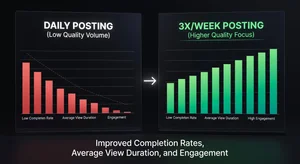
Creators who shifted to posting 3 high-quality videos per week from 7 average ones are consistently reporting better per-video performance, higher audience retention rates, and in many cases, total reach within 20% of their previous higher-volume output with dramatically less production time.
The burnout factor is also real. The creators who stayed on the daily-post treadmill into 2025 often either burned out and went dark entirely (disruptive to their audience and algorithmic momentum) or continued posting while visibly declining in creative quality. Both outcomes are worse for long-term career trajectory than the planned reduction to sustainable output.
Practical Strategy for the Depth-First Approach
The transition from volume to depth requires a planning mindset rather than a reactive mindset. Reactive content strategy posts whatever is happening now. Planning strategy identifies the 3-5 most valuable topics you can address in a given week and produces the best possible version of each.
For each video, define your single goal before production: what is the one thing the viewer should take away? If the answer has multiple parts, you either have multiple videos or you need to narrow the scope.
Apply the completion-rate test before you publish: watch your finished video from the perspective of a first-time viewer. At what point might they stop? If there's a specific moment that feels slow, redundant, or disconnected from the main value proposition, that's where you edit.
Production quality improvements that move completion rates most reliably, in order of impact: audio quality first (poor audio causes more instant exits than anything else), then edit pacing (removing dead time and um/ah moments), then visual quality, then graphics and post-production.
The Sustainable Creation Model
The endgame for a sustainable content career in 2026 isn't a specific posting frequency. It's a production system that can consistently deliver your quality standard without depleting your creative resources.
That looks different for every creator. Some can produce high-quality content three times per week. Some find their creative ceiling at one. The relevant question isn't what the algorithm theoretically rewards. It's what you can sustain at the quality level your audience has come to expect.
The creators who recognized this early now have the advantage of having built audiences around quality expectations while the market was learning this lesson. Audiences trained to expect thoughtful content are more loyal, more completion-oriented, and more willing to follow a creator across platforms and into paid products.
The short-form video market isn't dying. Short-form video fatigue means something more specific: audiences are becoming more discriminating about which short-form videos earn their completion. That's not bad news for creators who can meet the standard. It's significant news for those who can't.
The speed-first era had a good run. The creators who pivoted to depth while it still felt early now look prescient. The creators pivoting now are still ahead of the majority. The window is still open.