Social Media Automation with AI: 10 Ways to Save 80% Time | Cliptics
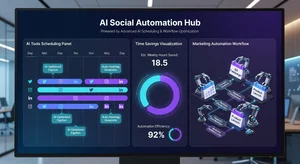
Social media management consumes an enormous amount of professional time. Research consistently shows that marketing managers spend an average of 6 hours per day on social media tasks: content creation, scheduling, engagement monitoring, performance analysis, and reporting. For small business owners who handle their own social media, that time comes directly out of activities that generate revenue.
AI automation has quietly transformed what is possible. Teams that have systematically applied AI tools to their social media workflows report time savings of 70 to 80%, with engagement metrics that match or exceed what they achieved with purely manual approaches.
Here are the ten highest-impact applications, organized from highest time savings to most strategic value.
1. AI-Powered Content Idea Generation
The blank page problem consumes hours that most creators do not track. Coming up with fresh content ideas that are relevant, timely, and on-brand is one of the most cognitively demanding parts of social media management.
Cliptics AI Content Idea Generator generates topic suggestions based on your niche, audience, and trending topics. Input your industry, a few audience characteristics, and content type preferences. The tool outputs a batch of specific, actionable content ideas with angle suggestions.
Time savings: Reduces idea generation from 2 to 3 hours per week to 15 to 20 minutes.
2. AI Hashtag Research and Generation
Hashtag research is tedious and constantly changing. What worked three months ago may be oversaturated or banned now. Manual hashtag research involves checking competitor posts, verifying hashtag volumes, checking for banned status, and assembling sets tailored to each post.
Cliptics AI Hashtag Generator generates optimized hashtag sets based on your content description. It accounts for platform differences (Instagram's current optimal hashtag count versus TikTok and LinkedIn's different conventions) and focuses on discovery-oriented hashtags rather than vanity-metric chasing.
Time savings: Reduces per-post hashtag research from 10 to 20 minutes to 2 to 3 minutes.
3. Content Repurposing Automation
Creating a piece of content once and distributing it once is the least efficient content model. The same core content can and should produce multiple platform-specific assets.
A 2,000-word blog post can become: a LinkedIn document carousel, an Instagram carousel with the key points, three short-form video scripts for TikTok and Reels, five to ten individual image quotes with key stats, a Twitter/X thread, and an email newsletter section. That is seven distinct pieces of content from one core piece.
AI tools help with the translation: converting blog content into appropriate formats for each platform, adjusting tone and length for each audience, and suggesting the visual assets needed.
Time savings: Reduces repurposing effort by 60 to 70% compared to manual adaptation.

4. Caption and Copy Generation
Writing engaging captions for every post is another significant time sink, especially for businesses maintaining presence across multiple platforms where each platform's optimal caption style differs.
Instagram rewards storytelling captions with a natural structure. LinkedIn prefers direct value statements with professional context. TikTok captions are often minimal since content speaks for itself. Facebook accommodates longer text but works best with conversational tone.
AI caption tools let you input the core message and context, then generate platform-appropriate variations simultaneously. Review, refine minimally, and post.
Time savings: Reduces caption writing from 20 to 30 minutes per post to 5 to 8 minutes.
5. Scheduling and Optimal Timing
Scheduling tools have existed for years, but AI-enhanced scheduling goes further. Rather than letting you choose when to post, AI scheduling tools analyze your specific account's historical performance data and identify when your particular audience is most active and responsive.
Tools like Buffer, Hootsuite, and Sprout Social all now incorporate AI-powered optimal timing recommendations. Combined with a full-week content batch scheduled in a single session, this eliminates daily posting time entirely.
Time savings: Reduces daily posting management from 30 to 60 minutes to a single weekly scheduling session of 1 to 2 hours.
6. AI-Generated Visuals
Creating visual content for every post is a bottleneck for teams without dedicated design resources. AI image generation has made it possible to create platform-appropriate visual assets without design skills or stock photo licensing fees.
For consistent brand visuals: generate AI images using your brand color palette and style preferences. For educational posts: create diagrams and infographic elements. For product content: generate lifestyle imagery using your product photos as reference.
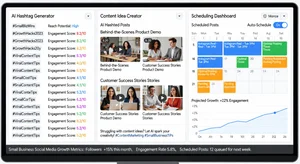
Time savings: Reduces visual asset creation from 1 to 2 hours per post to 10 to 20 minutes.
7. Comment and Engagement Monitoring
Keeping up with comments, mentions, and direct messages across multiple platforms is a constant monitoring task that interrupts deep work throughout the day.
AI-assisted social listening tools aggregate mentions across platforms, apply sentiment analysis, flag high-priority responses (negative comments requiring attention, key influencer mentions, potential customer service issues), and sometimes suggest response drafts.
This does not automate authentic engagement, but it transforms scattered monitoring into a consolidated review session.
Time savings: Reduces daily monitoring from continuous interruption to two focused sessions per day.
8. Performance Analytics and Reporting
Weekly or monthly social media reporting typically involves logging into multiple platforms, downloading data, aggregating in spreadsheets, and writing narrative summaries. This process can take 3 to 5 hours for a thorough report.
AI analytics tools pull data from multiple platforms, identify trends automatically, flag anomalies (sudden engagement drops or spikes), and generate narrative summaries of performance. The human role shifts from data assembly to strategic interpretation.
Time savings: Reduces reporting time from 3 to 5 hours to 45 to 90 minutes.
9. Social Listening and Trend Identification
Identifying relevant trends, conversations, and moments to participate in requires constant monitoring of the broader social landscape. Missing a relevant trend means missed engagement opportunities. Posting on an irrelevant trend looks tone-deaf.
AI social listening tools monitor specified keywords, competitor activity, and industry topics continuously. They surface relevant trending conversations in a single dashboard, letting you quickly identify which trends are worth engaging and which to ignore.
Time savings: Reduces trend monitoring from continuous scanning to brief daily review sessions.
10. Content Calendar Management
Managing a content calendar across multiple platforms, content types, and team members is an organizational challenge that grows with scale. AI-assisted calendar tools can suggest content mix (balancing educational, promotional, engagement-focused, and entertainment content), identify content gaps, and flag when the posting cadence is falling behind.
Time savings: Reduces calendar management overhead by 40 to 50%.
Building Your AI Social Media Stack
The platforms that give the best returns for AI automation investment are those with the highest volume of repetitive work. For most teams, that means idea generation, caption writing, hashtag research, and scheduling.
Start with those four and establish efficient workflows before expanding to other areas. The goal is to eliminate the repetitive cognitive work so that the strategic and creative work, which is irreplaceable by AI, gets more of your attention.
A streamlined social media workflow with AI tools running in the background is not about producing more content mechanically. It is about freeing the time and mental space to produce better content thoughtfully. The 80% time savings is a means to that end.