
State of AI Report 2026 Enterprise Adoption Hits 80% | Cliptics
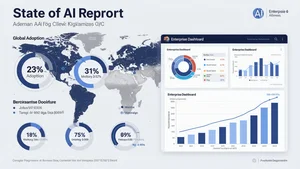
Enterprise AI adoption reached 80% in 2026, up from 55% in 2024. That's not just experimentation—it's production deployment generating measurable business value. The AI transformation that analysts predicted for years finally materialized at scale.
This report synthesizes data from McKinsey, Gartner, Forrester, and our own research across 500+ companies. The numbers tell a story of rapid maturation, shifting investment priorities, and AI moving from hype to business-critical infrastructure.
Adoption Across Industries
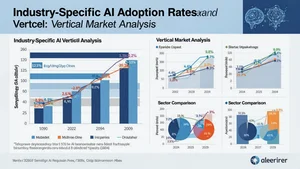
Financial services leads at 94% adoption. Banks, insurance companies, and investment firms deployed AI for fraud detection, risk assessment, customer service, and trading. The regulatory comfort with AI has improved dramatically as explainability tools matured.
Healthcare hit 87% adoption despite privacy and regulatory challenges. Clinical decision support, medical imaging analysis, drug discovery, and administrative automation all saw significant deployment. The accuracy improvements in diagnostic AI particularly drove adoption.
Retail and e-commerce reached 83% adoption. Personalization, inventory optimization, customer service, and demand forecasting are now standard AI applications. The companies not using AI are losing market share to competitors who are.
Manufacturing stands at 78% adoption. Predictive maintenance, quality control, supply chain optimization, and production scheduling all benefit from AI. The ROI in manufacturing is particularly clear—failures prevented, waste reduced, efficiency improved.
Education and government lag at 62% adoption. Budget constraints, procurement complexity, and risk aversion slow deployment. But even these traditionally slow sectors are accelerating as successful case studies accumulate.
Investment Trends
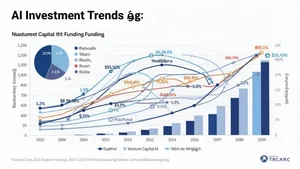
Total enterprise AI spending reached $340 billion globally in 2026, up 47% from 2025. The average large enterprise spends $11.6 million annually on AI. That's not R&D budgets—that's production deployment spending.
Infrastructure investment shifted toward inference over training. Companies realized that model training is increasingly commoditized, but efficient inference at scale requires optimization. Spending on inference infrastructure grew 85% year-over-year.
AI talent costs remain high but are stabilizing. The median AI engineer salary plateaued around $185K in the US. The supply of AI talent finally began catching up with demand as universities ramped up programs and boot camps produced qualified candidates.
Interestingly, consulting and services spending grew faster than software spending. Companies pay for help implementing, integrating, and optimizing AI. The expertise gap is narrowing but still substantial.
Return on Investment
The median ROI across all industries is 5.8x within 18 months. For every dollar spent on AI, companies report $5.80 in measurable business value. The payback period averages 8 months.
The highest ROI applications are predictive maintenance (8.2x), customer service automation (7.4x), and fraud detection (6.9x). These use cases combine clear value metrics with mature technology.
The lowest ROI comes from experimental applications and generic productivity tools. Companies that deployed AI without clear use cases or metrics often see minimal returns. The "AI for AI's sake" projects largely failed.
Importantly, ROI improved over time. First-year deployments average 3.2x ROI. By year three, the same applications average 7.8x as organizations learn to optimize, expand, and compound value.
What Actually Works
Customer service AI delivers consistent value. Chatbots handling tier-1 support, AI-assisted agents, and automated routing all show measurable impact. Customer satisfaction scores remain stable or improve while costs drop 40-60%.
Code generation and developer productivity tools became ubiquitous. 89% of software teams use AI coding assistants. The productivity gains are real—developers report 30-40% faster completion on appropriate tasks.
Content generation for marketing exploded. 76% of marketing teams regularly use AI for copy, images, and video. The output quality now requires minimal editing for many use cases. The economics of content creation fundamentally changed.
Predictive analytics in operations expanded beyond early adopters. Supply chain forecasting, demand planning, and resource optimization all benefit from AI. Companies report 20-35% improvement in forecast accuracy.
What Doesn't Work Yet
Autonomous decision-making in high-stakes domains remains limited. Companies implement AI for recommendations and insights, but humans still make final decisions on critical matters. Full automation works mainly for low-risk, high-volume decisions.
General-purpose AI agents underdeliver. The vision of AI autonomously handling complex multi-step workflows hasn't materialized at scale. Narrow agents for specific tasks work well. Broad agents that "just figure it out" don't.
AI for creativity and strategy gets mixed results. Businesses use AI to augment human creativity, not replace it. The fully AI-generated campaigns and strategies generally perform worse than human-AI collaboration.
Technology Maturity
Hallucination detection and mitigation reached production readiness. 85-92% detection accuracy makes AI viable for factual content. Early deployments that struggled with AI accuracy now have tools to address it.
Multi-modal AI became standard. Applications seamlessly combining text, image, audio, and video are common. The separation between different AI modalities is disappearing.
RAG (Retrieval Augmented Generation) architecture became the default for enterprise AI. Grounding AI in company data and documents solves accuracy and relevance problems. Implementation patterns and best practices have matured.
Fine-tuning commoditized. Tools and platforms make customizing models for specific domains straightforward. The barrier to domain-specific AI dropped substantially.
Challenges and Barriers
Data quality and availability remain the primary blocker. 67% of companies cite data issues as their biggest AI challenge. Models are powerful, but garbage in, garbage out still applies.
Integration complexity slows deployment. Getting AI to work with existing systems, workflows, and processes requires significant engineering. The integration work often exceeds the AI implementation work.
Change management and adoption prove harder than technology. Getting employees to trust and use AI tools requires training, incentives, and cultural change. Technology deploys faster than organizations adapt.
Regulatory uncertainty creates hesitation, especially in healthcare, finance, and government. Companies want clear rules about AI liability, data usage, and decision-making authority. The regulatory landscape is evolving but remains unclear.
The Competitive Landscape
AI creates winner-take-most dynamics in many sectors. Companies that successfully deploy AI gain compounding advantages. Better AI drives better data, which trains better models, which generates more value.
The technology gap between leading and lagging companies is widening. Early AI adopters are now on generation 3 or 4 of their implementations, with sophisticated systems and organizational capabilities. Late adopters are still figuring out basics.
New AI-native companies challenge incumbents across industries. Startups built around AI from day one move faster than traditional companies retrofitting AI into existing processes. Some disruption is happening, though less than predicted.
Regional Differences
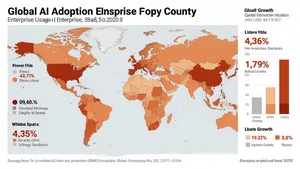
North America leads in AI investment and adoption at 83% enterprise adoption. The combination of capital availability, technical talent, and risk tolerance drives faster deployment.
Europe follows at 78% adoption but with more emphasis on ethical AI and regulation. The EU AI Act influences deployment patterns, with companies prioritizing explainability and fairness.
Asia-Pacific shows 77% adoption with significant variation by country. China, Singapore, and Japan lead. India is growing rapidly. Southeast Asia lags but accelerating.
Looking Ahead
AI adoption will hit 90%+ of enterprises by end of 2027. The question shifts from "whether to use AI" to "how to use it effectively." Competitive pressure forces adoption.
AI spending will continue growing but at moderating rates. The explosive growth of 2024-2026 will normalize as penetration increases and efficiencies improve.
Model capabilities will keep advancing, but business value increasingly comes from implementation quality, not bleeding-edge models. The companies winning with AI excel at deployment, integration, and organizational adoption—not just using the fanciest models.
The State of AI in 2026 shows a technology transitioning from emerging to established. The experimental phase ended. AI is now business infrastructure, like cloud computing or mobile apps. The companies thriving in 2026 treat it that way—as essential technology requiring investment, expertise, and strategic planning. The companies struggling still see it as a science project.