
Sustainable Web Design: Reduce Website Carbon Footprint by | Cliptics
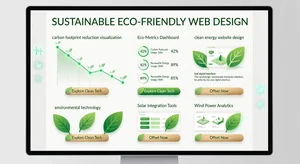
The internet uses more electricity than the entire country of Iran. Data centers consume approximately 200 terawatt-hours of electricity per year globally. Every byte transferred, every server processing a request, every device rendering a webpage has a carbon cost.
For most website owners, this is an invisible impact. But it is measurable, and it is reducible.
The good news is that the most effective techniques for reducing a website's carbon footprint overlap almost entirely with the most effective techniques for improving performance. A faster website is almost always a greener website. Sustainable web design is not a tradeoff between environmental responsibility and user experience. Done correctly, it improves both.
How to Measure Your Website's Carbon Footprint
Before optimizing, measure. The Website Carbon Calculator (websitecarbon.com) provides an estimate of how much CO2 your website produces per page view. Industry benchmarks suggest that an average webpage generates about 1.76 grams of CO2 per page view. Heavily optimized pages can get below 0.3 grams.
For a website with 10,000 monthly visitors, the difference between 1.76g and 0.3g per page view is:
- At 1.76g: 17.6 kg of CO2 per month (211 kg per year)
- At 0.3g: 3 kg of CO2 per month (36 kg per year)
That 83% reduction comes entirely from performance optimization decisions.
Tools for measurement:
- Website Carbon Calculator: Simple, free estimate per URL
- Google PageSpeed Insights: Performance data that correlates with energy consumption
- Ecograder: More detailed sustainability scoring
- EcoIndex: French tool providing precise CO2 estimates with methodology explanation
The Biggest Wins: Images
Images typically represent 60 to 80% of a webpage's total data transfer. They are the single most impactful target for carbon reduction.
The sustainable image optimization stack in 2026:
Convert to next-generation formats. WebP files are 25 to 35% smaller than JPEGs at equivalent visual quality. AVIF files are 50% smaller. Switching your image library to WebP alone can reduce your image-related carbon footprint by a third without any visible quality degradation.
Cliptics Image Compressor handles batch compression and format conversion.
Serve appropriately sized images. A header image that displays at 800 pixels wide does not need to be served at 2400 pixels. Use the HTML srcset attribute to serve different image sizes for different screen resolutions. Mobile visitors should receive appropriately sized images for their screens.
Set up lazy loading. Images below the fold should load only when the user scrolls toward them. Add loading="lazy" to all non-critical image tags. This reduces the initial data transfer for pages where visitors do not scroll to the bottom.
Set appropriate image quality. Quality levels of 75 to 80 on a 0-100 scale produce images that are visually excellent while being significantly smaller than quality 90 or 95 images. Most visitors cannot distinguish quality 80 from quality 95 in actual website viewing conditions.
Audit and remove unused images. CMS and ecommerce sites accumulate unused images in their media libraries over time. Unused images stored on servers consume storage energy even when not accessed.
Reducing JavaScript and CSS Weight
After images, JavaScript is the next largest contributor to page weight and processing energy.
Every byte of JavaScript must be downloaded and then executed by the user's device. Execution consumes CPU cycles, which consumes battery power on mobile devices and draws electricity on desktop devices.
Sustainable JavaScript practices:
- Tree-shaking: Remove unused code from your bundle. Modern build tools (Webpack, Rollup, Vite) can analyze which code is actually used and exclude the rest.
- Code splitting: Load JavaScript only when it is needed rather than loading the entire application upfront.
- Defer non-critical scripts: Use
deferandasyncattributes to prevent JavaScript from blocking page rendering. - Audit third-party scripts: Each analytics, advertising, chat, and marketing tool you add loads its own JavaScript. Audit your third-party script load regularly and remove tools you no longer actively use.
For CSS, similar principles apply: remove unused rules, minimize file size, and load only what the current page requires.
Green Hosting Choices
Where your website is hosted determines what energy powers the servers that serve it.
Traditional hosting runs on electricity from the grid, which in most regions includes significant fossil fuel generation. Green hosting providers power their data centers with renewable energy: solar, wind, and hydroelectric power.
When choosing or switching hosting providers, look for:
- Renewable energy percentage: 100% renewable is achievable and increasingly available.
- Carbon offsetting: Some providers offset their remaining emissions through verified carbon credits.
- Data center location: Data centers closer to your primary audience reduce transmission distances.
- Server efficiency: Modern data centers have Power Usage Effectiveness (PUE) ratings close to 1.0, meaning nearly all electricity goes to computing rather than cooling and infrastructure overhead.
Notable green hosting providers include GreenGeeks, DreamHost (100% renewable), SiteGround (renewable energy partner), and Kinsta (Google Cloud Platform, which operates on 100% renewable energy).
Efficient Code Architecture
Beyond images and JavaScript, architectural choices affect carbon footprint.
Static site generation over dynamic rendering: A static HTML page served from a CDN uses a fraction of the server processing energy of a dynamically rendered page. Where possible, pre-render pages at build time rather than rendering them on every request.
Server-side caching: Pages that are cached and served without regeneration consume minimal processing energy per request. Set up aggressive caching for pages that do not change frequently.
CDN distribution: Content Delivery Networks serve files from servers physically close to the visitor, reducing transmission distance. They also typically cache content efficiently, reducing origin server load.
HTTP/2 and HTTP/3: These protocols are more efficient at multiplexing multiple file transfers, reducing connection overhead.
Database query optimization: Slow database queries require servers to work harder for longer, consuming more energy. Index your database tables appropriately and audit slow queries.
Font Optimization
Web fonts are often overlooked in sustainability audits but can be significant.
Self-host fonts. Fonts loaded from third-party CDNs (Google Fonts, Adobe Fonts) require additional DNS lookups and connections. Self-hosting eliminates this overhead.
Limit font weights and styles. Each font weight and style (regular, bold, italic, bold italic) is a separate file. Load only the weights you actually use on the page.
Use font-display: swap. This tells the browser to display system fonts immediately while custom fonts load, preventing render-blocking.
Consider system fonts. System font stacks (fonts already installed on the user's operating system) require zero additional downloads and render instantly.
Setting a Carbon Budget
The most effective sustainable web design practices come from treating carbon impact as a design constraint from the beginning rather than an afterthought.
Define a carbon budget for each page: a maximum CO2 per page view target. Common targets for sustainable websites:
- Under 0.5g CO2 per page view: Good
- Under 0.3g CO2 per page view: Great
- Under 0.1g CO2 per page view: Excellent (achievable for simple, well-optimized pages)
Build testing for this budget into your deployment pipeline, similar to performance budgets for load time. Catch regressions before they reach production.
A sustainable web presence is achievable without sacrificing user experience or design quality. The techniques required are the same techniques that make websites faster, more accessible, and better for SEO. The sustainability benefit is an additional layer of value from work you should be doing anyway.
Start with images. The impact is immediate, the tools are accessible, and the carbon reduction is measurable from day one.