
"TikTok Replacing Google for Gen Z | Cliptics"
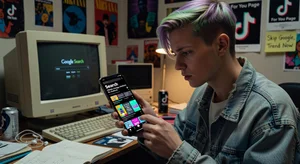
Something strange happened when I asked my younger cousin how to find a good ramen spot nearby. She didn't pull up Google Maps or type anything into a search bar. She opened TikTok, typed "best ramen near me," and scrolled through short videos of people slurping noodles and rating restaurants. Within thirty seconds she had her answer. I stood there watching like someone who just realized the world had moved on without sending a memo.
This isn't an isolated quirk. It's a full blown behavioral shift that's been quietly reshaping how an entire generation finds information. And in 2026, the numbers have gotten impossible to ignore.
The Numbers Behind the Shift
Google's own internal research first flagged this back in 2022 when a senior VP admitted that roughly 40 percent of young people were turning to TikTok or Instagram instead of Google Search or Maps when looking for a place to eat. Fast forward to now and that number has ballooned. Multiple studies from Semrush and other analytics platforms suggest that for Gen Z users aged 16 to 26, TikTok has become the first stop for everything from product recommendations to how to questions to news updates.
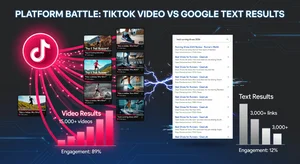
It's not that Google has gotten worse. Google still does what it has always done. The problem is that Gen Z doesn't want what Google offers. They don't want ten blue links and a knowledge panel. They want a real person holding up a product and saying "this changed my life" or showing them step by step how to fix a leaky faucet while their cat walks across the counter in the background. They want authenticity and visual proof. They want to see the answer, not read it.
And honestly? When you think about it from their perspective, it makes perfect sense.
Why Video Answers Hit Different
There's a psychological layer here that's worth exploring. Text based search results require you to evaluate credibility through signals like domain authority, writing quality, and whether the site looks trustworthy. That's a lot of cognitive work. Video short circuits that entire process. You see a real person in a real place doing the real thing. Your brain processes trustworthiness almost instantly based on facial expressions, tone of voice, and environmental context.
When someone on TikTok shows you their skincare routine and you can see their actual skin, that carries more weight than a thousand word article on a beauty blog you've never heard of. When a mechanic films themselves under the hood explaining what that clicking noise means, that's more convincing than a forum thread from 2019.
This is a fundamental change in what "searching" means. For Gen Z, search isn't about finding documents. It's about finding people who have already done the thing you want to do.
What TikTok Gets Right That Google Doesn't
TikTok's search experience is built on discovery. You type something in and you get a curated feed of short videos ranked by relevance and engagement. But here's the clever part: even before you search, TikTok's algorithm is already surfacing content it thinks you'll want based on your watch history and interaction patterns. The search bar is almost secondary. The entire app is a search engine that runs in the background.
Google, by contrast, is reactive. It waits for you to ask a question, then delivers results. It doesn't anticipate. It doesn't show you things you didn't know you needed. Yes, Google has the Discover feed and YouTube Shorts, but those features feel bolted on rather than native to the experience.
There's also the format advantage. TikTok videos are typically 15 to 60 seconds. You get the answer fast. Google results often lead to blog posts where you have to scroll past life stories and ad blocks to find the one paragraph that actually answers your question. Gen Z grew up with instant everything. They don't have patience for that.
The Credibility Problem Nobody Talks About
Here's where things get complicated. TikTok is a terrible place to find verified information. The platform's recommendation algorithm prioritizes engagement over accuracy. A confident sounding person giving completely wrong medical advice will outperform a boring but correct explanation from an actual doctor almost every time.
I've seen TikTok videos claiming you can cure infections with garlic, that certain tax loopholes will save you thousands (they won't and might get you audited), and that specific job interview tricks are guaranteed to work (they aren't). These videos get millions of views because they are delivered with the conviction and energy that the algorithm rewards.
Google has spent two decades building systems to surface authoritative, accurate information. Their E-E-A-T framework (Experience, Expertise, Authoritativeness, Trustworthiness) specifically tries to push credible sources to the top. TikTok has no equivalent. The most engaging answer wins, regardless of whether it's correct.
This creates a strange dynamic where Gen Z trusts the format (video from a real person) while being more susceptible to misinformation within that format. They've traded one set of biases for another.
How Businesses Are Adapting
Smart businesses figured this out early. If your customers are searching on TikTok, you need to be discoverable on TikTok. This has spawned an entire industry around TikTok SEO, which focuses on optimizing video captions, hashtags, and on screen text for TikTok's search algorithm.
Restaurants are creating short videos showcasing their signature dishes. Service businesses are posting how to content that demonstrates their expertise. Ecommerce brands are building entire content strategies around TikTok search terms rather than Google keywords.
The shift has also changed influencer marketing. It used to be about reach and brand awareness. Now it's about search visibility. Brands want creators to make content that ranks for specific search queries on TikTok, not just content that goes viral.
YouTube has responded with Shorts. Instagram has Reels with improved search functionality. Even Google itself has started integrating TikTok and Instagram content into its own search results, essentially acknowledging that the answers people want increasingly live on social platforms.
What This Means for Content Creators
If you create content of any kind, this shift matters for you. The traditional blog post optimized for Google is not going away, but its audience is aging. The next generation of information seekers expects video first, text second.
This doesn't mean you need to abandon written content. It means you need to think about distribution differently. A single piece of research can become a blog post for Google, a TikTok for social search, a YouTube Short for video search, and an Instagram Reel for visual discovery. The content stays the same. The format adapts to where each audience searches.
The creators who will thrive are the ones who understand that search is no longer a single platform activity. It's a multi platform behavior where different demographics use different tools to find the same information.
The Bigger Picture
What fascinates me most about this shift is what it reveals about how trust works. Every generation develops its own trust signals. Boomers trusted newspapers and encyclopedias. Gen X trusted search engines and review sites. Millennials trusted social proof and user ratings. Gen Z trusts individual creators who feel genuine.
None of these trust models are perfect. Each one comes with blind spots. Newspapers had editorial biases. Search engines can be gamed with SEO. User ratings can be faked. And creator content can be misleading.
The real lesson here isn't that TikTok is better than Google or that Google is obsolete. It's that the very concept of "searching for information" is evolving beyond what any single platform can contain. We're moving toward a world where the best answer might live on TikTok, or Google, or YouTube, or Reddit, or a podcast, or a community forum. The platforms that win will be the ones that help people find the right answer regardless of where it lives.
For now though, if you want to reach Gen Z, you need to be where they're looking. And increasingly, that's not the search bar their parents used.