Virtual Sunglasses Try-On: Find Perfect Frames for Your | Cliptics
I spent three hours last weekend scrolling through sunglasses online. Three hours. Added a dozen pairs to my cart, removed them all, then closed the laptop feeling defeated.
Sound familiar? Here's the thing that finally changed everything for me: virtual try on technology. It took what used to be a total guessing game and turned it into something that actually works. And honestly, it's kind of wild that more people aren't using it yet.
So let me walk you through what I learned about finding the perfect sunglasses for your face shape, which tools actually deliver, and why this technology is about to make blind online eyewear shopping a thing of the past.
Why Most People Buy the Wrong Sunglasses
Here's a stat that blew my mind. Nearly 60% of people who buy sunglasses online end up returning them. Sixty percent. That's not a small number. And the top reason? They looked completely different on their actual face than they did on the model.
Makes sense, right? A pair of oversized aviators looks incredible on someone with a strong jawline and wide cheekbones. Put those same frames on a narrow face and suddenly you look like a kid wearing dad's glasses. The problem was never about taste. It was about fit.
This is where understanding your face shape becomes genuinely useful. Not in a vague "oh, you should try cat eye frames" kind of way. In a practical, this will save you money and frustration kind of way.
The Face Shape Breakdown (Without the Fluff)
You've probably seen those charts that categorize faces into shapes. Oval, round, square, heart, oblong. They're everywhere. But most of them stop at the label and never tell you what to actually do with that information.
So let me make this simple.
Round faces have soft angles and roughly equal width and length. The goal is adding definition. Angular frames like wayfarers or rectangular styles create contrast that sharpens your features. Avoid perfectly round frames because they just echo the shape you already have.
Square faces have a strong jaw and broad forehead. You want to soften those angles. Round or oval frames work beautifully here. Aviators are your best friend. Stay away from boxy rectangular frames that make everything look even more angular.
Oval faces get the easiest deal. Most frame styles work. Seriously. The proportions are balanced enough that you can experiment freely. Just keep the frames roughly as wide as the broadest part of your face and you're golden.
Heart shaped faces are wider at the forehead and narrow at the chin. Bottom heavy frames or aviators help balance things out by drawing attention downward. Rimless or light colored frames also work well because they don't emphasize the wider upper half.
Oblong faces are longer than they are wide. The trick is adding width. Oversized frames, wrap styles, and decorative temples all create the illusion of a wider face. Tall frames also help break up the length.
How Virtual Try On Actually Works
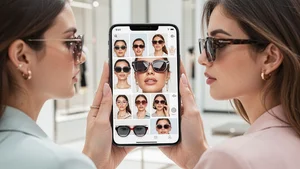
The technology behind virtual try on tools is legitimately impressive. Your phone or webcam captures your face, then AR (augmented reality) maps the sunglasses onto your features in real time. It tracks your facial landmarks, things like the bridge of your nose, the width between your temples, and your ear placement, to position the frames accurately.
The best tools go beyond just overlaying a flat image. They account for depth, lighting, and even how the frames would cast shadows on your face. Some can detect your face shape automatically and suggest styles that complement your features before you even start browsing.
This isn't gimmicky tech. It's solving a real problem. When you can see how frames actually sit on your face, from multiple angles, with accurate proportions, your confidence in buying goes way up. And those return rates? They drop significantly.
Tools That Actually Deliver
Not all virtual try on experiences are created equal. Some feel like looking through a funhouse mirror. Others are so accurate you forget you're not physically wearing the glasses.
Cliptics Virtual Try On for Sunglasses is one of the standout options right now. It uses advanced face mapping to show you exactly how different frames sit on your specific face shape. The rendering is smooth, the frame positioning feels natural, and you can compare multiple styles side by side without the awkward lighting issues that plague other tools.
Warby Parker pioneered mainstream virtual try on and their setup remains solid. The app lets you save looks and share them with friends for opinions, which is honestly how most sunglasses decisions get made anyway.
Ray Ban's tool focuses on their own catalog obviously, but the AR quality is top notch. If you already know you want Ray Bans, their try on experience will help you narrow down which specific model works best.
Zenni and EyeBuyDirect offer budget friendly options with decent virtual try on features. They're not as polished as the premium tools, but when you're shopping in the $20 to $50 range, having any try on capability beats guessing.
The Trick Nobody Talks About
Here's something I figured out through trial and error. Don't just try on sunglasses straight on facing the camera. That's one angle. One moment. One expression.
Turn your head slightly. Smile. Look down like you're checking your phone. Tilt your chin up. These are the angles other people actually see you from. A pair of frames might look perfect in a straight on selfie view but feel completely wrong from a three quarter angle.
The best virtual try on tools let you move naturally while the AR tracks in real time. Use that. Spend an extra thirty seconds per frame just moving around. It will tell you more than any product photo ever could.
Beyond Sunglasses
Once you've nailed down your face shape and gotten comfortable with virtual try on, that knowledge transfers everywhere. Try on hats virtually using the same principles. Wide brimmed hats balance narrow faces. Structured caps complement round faces. The face shape framework works across accessories.
And the technology keeps improving. The gap between virtual try on and physically trying something on shrinks every year. We're getting to the point where the AR version is arguably better than the in store experience because you can try fifty styles in five minutes without a single salesperson hovering nearby.
What I'd Actually Recommend
If you're sitting there right now thinking about buying sunglasses online, here's my honest advice.
First, figure out your face shape. Take a photo straight on with your hair pulled back. Look at it objectively. Compare it to the descriptions above. Don't overthink this part.
Second, open a virtual try on tool and spend fifteen minutes just exploring. Don't buy anything yet. Try frames you'd never normally pick. Try styles you think are "not you." I discovered I look surprisingly good in round frames after years of only wearing wayfarers, and I never would have tried them in a store.
Third, when you find two or three contenders, do the multi angle test. Move around. See them in different lighting. Sleep on it if you need to.
The whole point of this technology is removing the pressure. No sales associate. No limited selection. No trying to remember what pair number three looked like while you're wearing pair number seven. Just you, your face, and all the frames you could want.
Shopping for sunglasses should be fun. Virtual try on finally makes it that way.