
"Virtual Try-On Is Changing How We Shop for Fashion in 2026 | Cliptics"
Last month, I watched my sister buy an entire spring wardrobe without stepping inside a single store. She sat on her couch, coffee in hand, trying on jacket after jacket on her phone screen. When the packages arrived three days later, she kept every single item. Not one return. That would have been unthinkable even two years ago.
Something fundamental has shifted in how we shop for fashion, and virtual try-on technology is at the center of it. What started as a novelty, those early AR filters that slapped a blurry shirt graphic over your body, has matured into something that actually changes behavior. People aren't just experimenting with virtual try-on anymore. They're relying on it.
The Moment It Stopped Being a Gimmick
There was a tipping point. Sometime around late 2025, the technology crossed an invisible threshold where the gap between what you see on screen and what you get in the box became negligible. The fit predictions got eerily accurate. The fabric simulations started accounting for how materials actually behave on different body types. And suddenly, returning clothes because they looked nothing like the preview became rare.
I remember trying on a pair of sunglasses through Cliptics virtual try-on for sunglasses and being genuinely surprised. The frames sat on my face correctly. The proportions matched. Even the way the lenses reflected light felt real. That was my moment of "okay, this actually works."
Retailers noticed the shift too. Zara reported that items with virtual try-on enabled had 38% lower return rates compared to standard product pages. ASOS rolled out virtual fitting across their entire catalog in early 2026 after a pilot showed that customers who used the feature spent 23% more per order. The economics make the technology inevitable.
What Changed Under the Hood
The reason virtual try-on feels different in 2026 isn't one breakthrough. It's a stack of improvements that compound.
Body mapping got dramatically better. Current systems capture over 200 measurement points from a single photo. They understand not just your height and width but how your shoulders slope, where your natural waist sits, and how your posture affects fit. That level of detail means the AI knows whether a structured blazer will gap at the chest or whether those high waisted jeans will actually hit at your waist.
Fabric simulation caught up with reality. This was the hardest problem to solve. Silk drapes differently than denim. Knits stretch in ways wovens don't. The AI models now simulate material behavior based on actual physics, not just visual approximation. When you see a linen shirt on screen, it wrinkles and folds the way linen actually does.
Lighting adaptation sealed the deal. The system reads your environment and renders clothing with matching light sources. If you're standing near a window with warm afternoon light, the virtual garment picks up that same warmth. No more flat, pasted-on look that screamed "this is fake."
Real Stories from Real Shoppers
Talk to people who've integrated virtual try-on into their shopping habits and you hear the same themes over and over.
Sarah, a marketing director in Chicago, told me she discovered her actual style through virtual try-on. "I always grabbed the same safe choices in stores because fitting rooms are exhausting and I didn't want to waste time. Online, I started trying things I never would have picked up. Turns out I look great in structured coats and terrible in oversized sweaters. I never would have learned that in a store."
Marcus runs a small streetwear brand and virtual try-on changed his business model entirely. "We went from a physical pop up to online only in six months. Our customers try everything on through Cliptics virtual try-on before ordering. Returns dropped from 30% to 8%. That's not a small improvement, that's the difference between profitable and not."
Then there's the accessibility angle that doesn't get enough attention. People with mobility challenges, those who live far from shopping centers, parents who can't easily get to stores, anyone who feels anxious in fitting rooms. Virtual try-on opened fashion to people who were previously underserved by the traditional retail experience.
The Watch and Accessories Revolution
Clothing gets the headlines, but accessories might be where virtual try-on has had the most practical impact. Watches in particular.
Buying a watch online used to be a leap of faith. Does a 42mm case look right on my wrist? Will the band color work with my skin tone? Is the face too busy or too minimal for my taste? These questions kept people tethered to jewelry stores and boutiques.
Now you can virtually try on watches and see exactly how different sizes, styles, and bands look on your actual wrist. The technology maps your wrist dimensions, accounts for your skin tone, and renders the watch with accurate proportions. Luxury watch brands that resisted e-commerce for decades are now seeing 40% of sales come through virtual try-on enabled online channels.
Sunglasses follow the same pattern. Frame shape matters enormously for face shape, and the old approach of trying twenty pairs in a store while your friend gives vague opinions has given way to AI recommendations that actually understand facial geometry. The system considers face width, nose bridge height, cheekbone placement, and brow line to suggest frames that complement your features.
What This Means for E-Commerce Businesses
If you run an online store and haven't set up virtual try-on yet, you're leaving money on the table. The data from 2026 is clear.
Conversion rates jump 25 to 40% when virtual try-on is available. Shoppers who use the feature buy more confidently and buy more items per session. Average order values climb because people are willing to experiment with higher priced pieces when they can see them on their body first.
Return rates drop dramatically. For apparel specifically, the industry average sits around 30% for online purchases without try-on. With it, that number falls to 10 to 15%. Every avoided return saves shipping costs, processing time, and prevents perfectly good clothing from ending up in landfills.
Customer loyalty increases measurably. Shoppers who use virtual try-on features are 2.3 times more likely to return to the same retailer within 60 days. The feature creates stickiness that's hard to replicate with discounts or loyalty programs.
The Privacy Question Everyone's Asking
When you upload a photo of your body for virtual try-on, where does that data go? It's a fair question and the answer has improved significantly.
Most modern platforms process body data on your device. The AI runs locally, generates the visualization, and your photo never leaves your phone. Platforms like Cliptics are transparent about this. Your body measurements aren't stored, sold, or used for purposes beyond the try-on session unless you explicitly opt into saving them for future visits.
The regulations caught up too. Data protection laws in the EU, California, and a growing number of jurisdictions now classify body measurement data as biometric information with strict handling requirements. Companies that want to compete in this space have to be responsible about it, which is actually good for consumers.
What Still Needs Work
Virtual try-on isn't perfect. Being honest about its limitations matters because it builds trust in what the technology does well.
Very loose, flowing garments remain tricky. A billowing maxi dress or an oversized trench coat can be harder for the AI to simulate accurately, especially in motion. The fit prediction is solid but the visual representation sometimes misses the "feel" of very lightweight fabrics.
Color accuracy depends on your screen. The AI can simulate perfect color, but if your phone display runs warm or cool, the shade you see won't exactly match reality. This matters more for nuanced colors like olive green or dusty rose.
Custom tailoring still requires a human. Virtual try-on can tell you a lot about how standard sizes fit, but if you're getting a suit tailored or a dress altered, the technology supplements rather than replaces a skilled tailor.
Where This Goes Next
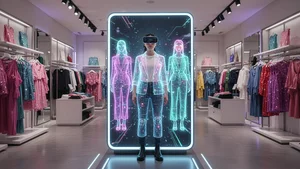
The trajectory is obvious and exciting. AR mirrors in physical stores are already showing up, letting you see yourself in outfits without undressing. Social try-on features are connecting friends across distances for collaborative shopping sessions. AI stylists are combining virtual try-on data with your existing wardrobe to suggest complete outfits.
The biggest shift might be cultural. A generation of shoppers is growing up with virtual try-on as their default first step. They'll try before they buy, always. The impulse purchase of something that doesn't fit will become as outdated as burning a CD. Fashion retail is being rebuilt around the idea that seeing yourself in something should be effortless, instant, and free.
And honestly, given what I've seen my sister accomplish from her couch, I think that future is already here.